When should you schedule stair renovation during a home renovation?
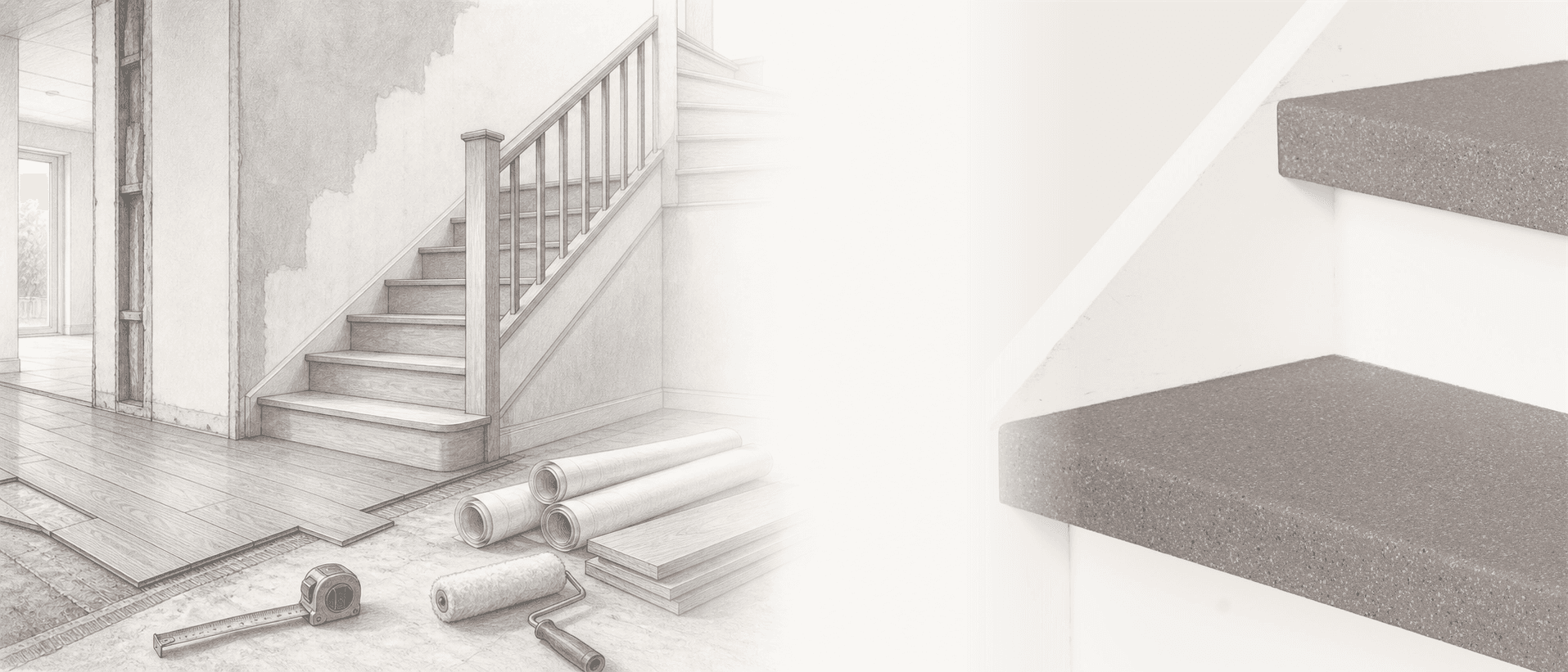
Anyone renovating a hallway, landing or entire home will eventually face the same question: where should the staircase fit into the schedule?
It is a question with practical consequences. A staircase finished too early becomes the access route for builders, tools and materials throughout the rest of the renovation. A staircase measured too late will not connect properly to the new floor. Both mistakes are expensive to correct afterwards, and both can be prevented by making one decision at the outset.
Short answer
Stair renovation belongs near the end of the schedule: after demolition and plastering, after painting the stairwell and after the floors upstairs and downstairs. The staircase is part of the finishing work, not the structural phase. Measuring, however, takes place much earlier — as soon as the final floor build-up has been determined, even if the floor has not yet been installed.
In what order should the work be scheduled?
For a renovation that includes the staircase, the logical sequence is as follows.
Step 1: Demolition and structural work
Demolition, moving walls, services and anything that creates dust, vibration or heavy traffic. During this phase, the existing staircase carries all construction traffic. If the staircase creaks or has loose components, this is also the time to repair the structure — not later, beneath a new finish.
Step 2: Plastering and wall finishes
Plastering in the stairwell is wet work that can end up on the stringers and treads. It also introduces moisture into the space, which affects wooden components. This phase must be completely dry before a finish is applied to the staircase.
Step 3: Painting the stairwell
This includes the walls and ceiling and, if they are being retained, the stringers, handrail and balustrade. A painter working in a stairwell stands on the treads and may spill paint on them. That is far less serious on an old tread than on a new one.
Step 4: The floors upstairs and downstairs
The floor determines where the staircase begins and ends. If the floor is installed after the staircase, the height of the first riser changes by the full floor build-up — underlay, screed and top layer combined. That is not merely a cosmetic detail.
Step 5: Stair renovation
Once the rest is finished and the dust has settled. Installation takes one working day for most systems, allowing the staircase to be scheduled late without delaying completion. The exact timescale is explained in how long stair renovation takes.
Why the floor should always come before the staircase
A staircase is a series of equal riser heights. If the downstairs floor becomes thicker or thinner, only the first riser changes, making it different from all the others. You may not consciously notice a difference of one or two centimetres, but your foot anticipates a consistent height — and the first or last tread is precisely where most trips occur.
The same applies upstairs where the staircase meets the landing. In addition, the visible transition between the floor and top tread can only be finished neatly if both dimensions are known before production. The material options for this transition are explained in combining a wooden floor with Stone or Terrazzo on the staircase.
When should the staircase be measured?
This is where problems often arise in practice. Because prefabricated components require production time, measurements must be taken several weeks before installation — usually while the renovation is still in progress. That is perfectly possible, provided the final floor build-up has been documented: the underlay, screed, top layer and total height.
What does not work is measuring on the understanding that “some kind of floor will still be added”. Confirm the dimension with the flooring installer before the surveyor arrives and pass it on. This prevents a discussion on installation day, when there is no longer any room to make adjustments.
Common misconception: the staircase can be fitted in between other work
Because installation takes only one day, it is tempting to schedule it early when there happens to be a gap in the programme. The new staircase may then endure weeks of construction traffic: ladders, toolboxes, bags of rubble and paint buckets. Dust and sand also act as abrasives beneath footwear.
If there is no alternative — for example, because the staircase is the only access to the upper floor and the schedule changes — professional protection should be part of the agreement, not left to good intentions. Record who will protect the staircase, what they will use and for how long.
Expert note
The two questions we most often hear too late are: “How thick will the floor actually be?” and “Can the plasterer continue using the staircase for another week?” Both can be answered in five minutes at the start of a renovation but cannot be resolved at the end. Include the staircase in the schedule from day one — measure early and install late — and it will require no further attention. — Omnistair, Waddinxveen
The Omnistair view
A system with minimal build-up height simplifies planning because the staircase dimensions barely change. The stair nosings do not need to be shortened and the overall staircase height remains virtually unchanged, allowing the renovation to be scheduled as finishing work rather than a structural intervention. The practical implications are explained in stair renovation without shortening the stair nosings.
If you are still deciding whether to renovate or replace the existing staircase, that choice will also affect your schedule: read buying a new staircase or renovating the existing one. If you have a quarter-turn staircase, spiral staircase or landing, preparation requires more time — read how long a complex stair renovation takes.
Have your staircase assessed
Would you like to know where stair renovation fits into your renovation schedule? Have your staircase assessed by a selected Omnistair installer, or arrange a visit to the Experience Center in Waddinxveen.
Frequently asked questions
Can the staircase be renovated before the new floor is installed?
It can, but only if the complete floor build-up has been finalised and provided in writing at the measuring stage. The first riser is then calculated for the future floor height. If the floor subsequently differs, the connection will no longer be correct and is difficult to rectify.
Should the staircase be painted first?
The components that remain visible should be painted first: the stringers, handrail, balustrade and sometimes the risers. The treads themselves should not, as the new finish will cover them. If you are considering painting as an alternative to renovation, read painting a staircase or stair renovation.
How much time should I allow in my schedule?
Allow one working day for installation on a straight staircase, and longer for open staircases and bespoke work. For the full process from measuring to installation, allow several weeks of production time. Schedule the measurement early, even if installation is not planned until the end.
Can I use the staircase on the day of installation?
Not during installation, and immediately afterwards it depends on the system and adhesives used. Bear in mind that the upper floor may be inaccessible for part of a day or a full day, and prepare anything you will need beforehand. Read more in whether the staircase can be used immediately after renovation.
What if my staircase creaks — when should this be addressed?
Before renovation, during the structural phase. A new finish does not eliminate movement in the structure, and afterwards the underlying staircase cannot be accessed without damaging the finish. See renovating a creaking staircase.
Does the same sequence apply to an owners' association stairwell?
Broadly speaking, yes, with one difference: a communal stairwell cannot be closed because residents need continued access. Work is therefore often divided into phases, with an access route remaining available at all times. See stair renovation for owners' associations and commercial buildings.
Read more
Related knowledge-base articles
How long does a stair renovation take? From quote to completion
How long does a stair renovation really take? From quote to completion — all phases, average timelines per system and what extends installation time.
Read more →
Using the staircase after renovation — when is it possible?
When can you use the staircase after a stair renovation? Read per system about walkability, drying time and what to know on the day of installation.
Read more →
How long does a complex stair renovation take?
How long does renovating a quarter-turn staircase, spiral staircase or staircase with a landing take? Discover the timeline of complex staircases and Signature bespoke work.
Read more →