Does a staircase become noisier after stair renovation?
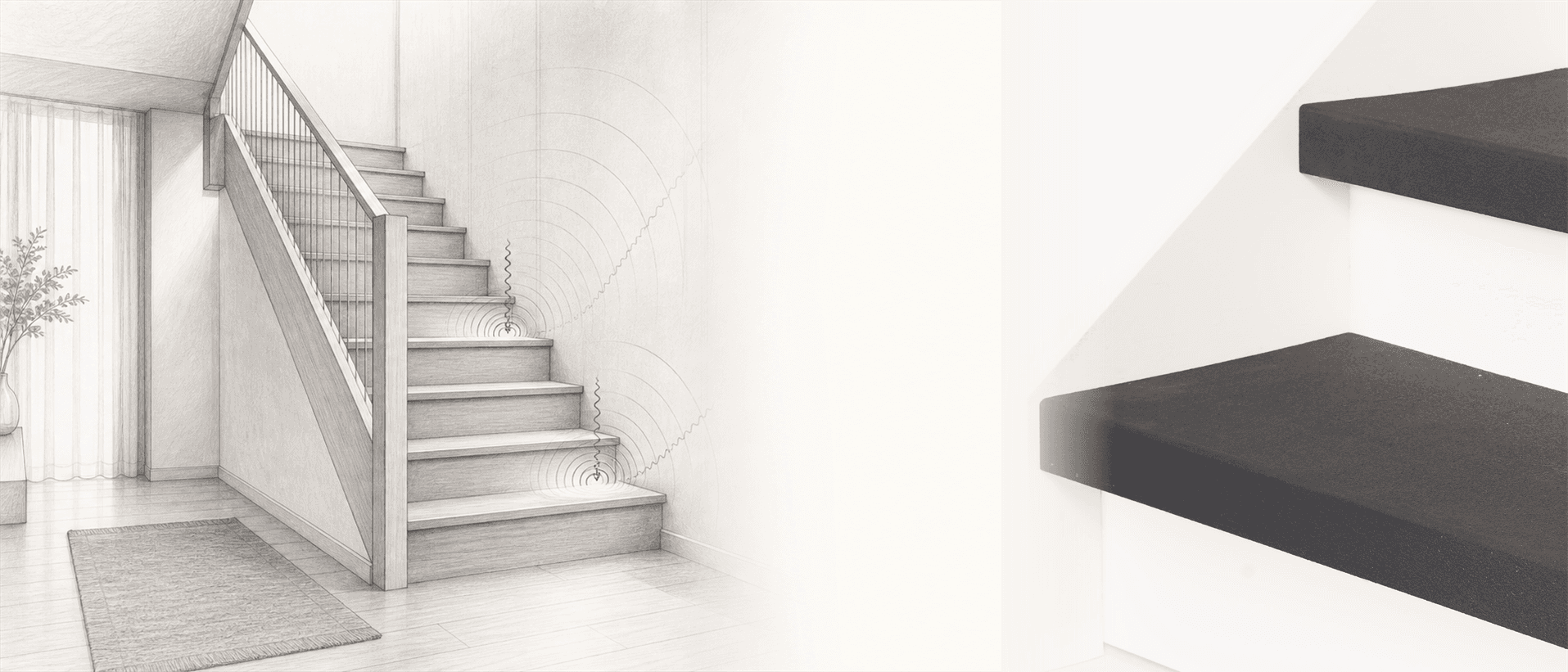
Yes, usually — but less than most people fear, and it can largely be controlled. Carpet absorbs footfall noise; a hard finish does not. What you hear after renovation depends on three factors: how the new tread sits on the substrate, how the staircase is incorporated into the building and how bare the stairwell is. This article explains where the noise comes from, which choices affect it and what can still be done afterwards.
Two types of noise that are often confused
The first is impact noise: the sound of a heel, a dog's claw or a child's foot striking the tread. This sound originates at the point of contact and travels through the staircase structure. The second is reverberation in the stairwell: a tall, bare space with hard walls reflects sound, making everything seem louder than it is. This is room acoustics and has little to do with the tread itself.
The distinction is important because the solutions are entirely different. Changing the tread will not solve reverberation.
Why removing carpet makes the biggest difference
Carpet with underlay is a soft, porous layer that performs two functions at once: it dampens the impact at its source and absorbs reverberation in the stairwell. Replacing carpet with wood, laminate, PVC or stone composite removes both functions in a single step. The audible difference therefore comes mainly from the change from soft to hard, and much less from the particular hard system you choose. The broader comparison is explained in carpet or hard flooring on the stairs.
Does the system build-up make a difference?
Yes, but not in the way most people expect. The sound of an impact is determined not by tread thickness but by how solidly the tread contacts the substrate. A tread bonded across its entire surface, with no air gap beneath it, sounds solid and muted. If there is space underneath — because adhesive was applied only at certain points or the substrate was uneven — that space acts as a resonating chamber and creates a hollow sound.
Installation therefore matters more than product choice. A thin tread bonded directly over the existing tread and stair nosing adds no hollow space; this situation is explained in stair renovation without shortening the stair nosings.
To be clear, no hard stair finish sounds like carpet. Anyone seeking near silence on the stairs will need to retain a textile covering on the treads.
Creaking is different from footfall noise
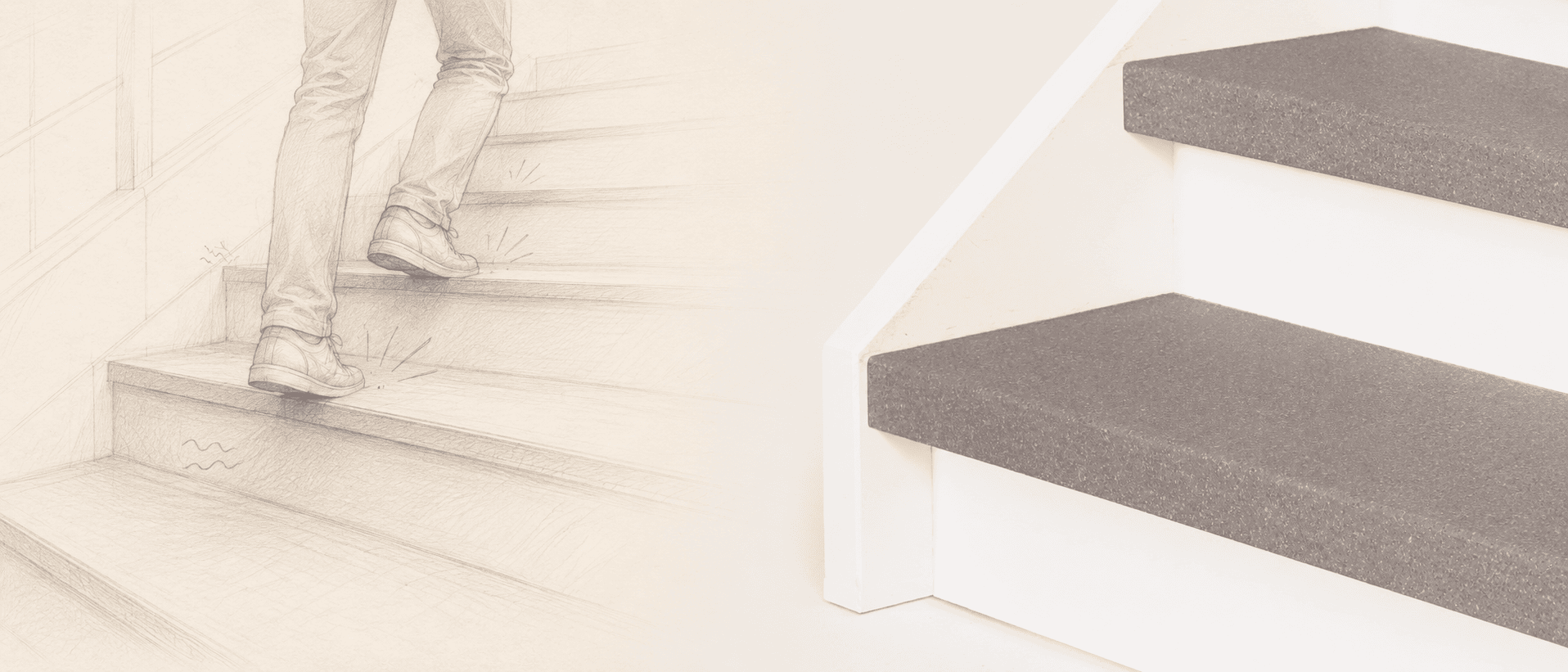
A creaking staircase makes noise because components in the structure are moving: timber that has shrunk, a wedge that has worked loose or a joint that has developed play. A new finish does not always conceal this and may make it more noticeable once the carpet that previously dampened it has been removed. Creaking should therefore be addressed before renovation, not afterwards. The causes and when repair is worthwhile are explained in renovating a creaking staircase.
What does help?
The greatest improvement can be achieved during renovation. Full-surface bonding to a level substrate prevents hollow resonance. Closed risers eliminate the resonating-chamber effect beneath an open staircase — with an open staircase this is a decision that can only be made once. Sealing gaps between the stringer and wall also makes more difference than you might expect because sound travels directly through them.
There are also measures that can be taken afterwards. A properly secured stair runner or individual stair mats along the walking line dampen impact and absorb reverberation; make sure they are firmly fixed, as a runner that shifts creates a fall risk. Anything soft in the stairwell also helps: curtains, a wall hanging or a runner on the landing. The most underestimated measure costs nothing — remove your shoes at the front door.
In an owners' association or commercial-building stairwell
In these settings, complaints are rarely about the impact on the tread and almost always about reverberation: a tall, bare space with hard walls, hard floors and nothing to absorb sound. In that case, acoustic measures belong on the ceiling and walls, not on the tread. If a staircase adjoins or forms part of a dwelling, impact noise can travel towards neighbouring properties; have this assessed in advance and include it in the project scope rather than addressing it after the treads have been installed. The other requirements for communal stairwells are explained in stair renovation for owners' associations and commercial buildings.
A realistic expectation
You will notice the difference during the first week. After that, your hearing adjusts to the new sound and it fades into the background. Persistent complaints are almost always about reverberation in a bare hallway or creaking that was already present — rarely about the tread itself. Identifying which issue applies beforehand allows you to choose the right measure and avoids having to place a runner over a newly renovated staircase afterwards.
Frequently asked questions
Does a stone-composite staircase sound louder than a wooden staircase?
The difference between hard materials is small compared with the difference between a soft and hard finish. Their sound character does differ: stone composite bonded across its entire surface to a solid substrate generally produces a shorter, duller impact than a thin panel with space beneath it. The build-up is therefore the main determining factor, not the material itself.
Does a stair runner reduce footfall noise?
Yes, it is the most effective measure that can be added afterwards. A runner dampens impact and absorbs reverberation while leaving the sides of the treads visible. Proper fixing is essential: a runner that can shift creates a greater problem than the noise you intended to solve. Read more about safe stair use in making stairs safer.
Can a sound-dampening layer be installed beneath the treads?
With systems that are bonded across their entire surface, an intermediate layer is not an independent choice: it affects adhesion, levelness and therefore the warranty. If you are considering this, discuss it with the installer during the site survey — not after the treads have been installed.
Why does my staircase sound hollow after renovation?
A hollow sound usually indicates space between the finish and the substrate: insufficient bonding or a substrate that was not level enough. Report this to the installer who fitted the staircase. It is an installation issue and can be rectified in most cases.
Is a thicker tread quieter?
Not automatically. Mass helps in itself, but what you hear is determined mainly by contact with the substrate. A thick tread with an air cavity beneath it sounds louder than a thin tread bonded across its entire surface. In stair renovation, thickness is not a measure of quality in any case — it mainly determines whether the stair nosings need to be shortened.
Will our communal stairwell become more reverberant after renovation?
If carpet or a soft coating is removed, that is certainly possible. Reverberation is addressed at the walls and ceiling rather than at the tread. Include acoustics in the project scope, particularly in buildings where residents already complain about noise in the stairwell.
Have your staircase assessed
Unsure about noise, creaking or reverberation in your stairwell? An installer with system expertise can assess the situation on site and advise what can be achieved during renovation. You can request an appointment through omnistair.nl.
Basis for this article
This article is based on Omnistair product documentation, installation guidelines and practical experience from stair-renovation projects. An on-site assessment is always required to evaluate sound transmission in multi-storey buildings.
Omnistair develops and supplies its own stair-renovation systems made from recycled natural stone composite. Advice, assessment and installation are provided through selected dealers and installers.
Read more
Related knowledge-base articles
Renovating a creaking staircase
A creaking staircase is a structural problem, not a surface problem. Discover why thick overlay treads can make creaking worse and how mechanical fixation, sealing, and sound-dampening bonding deliver a lastingly quiet staircase.
Read more →
Stair renovation maintenance — how do you keep a renovated staircase in good condition?
How do you maintain a renovated staircase? A calm overview of maintenance principles, what maintenance depends on and how a closed surface structure makes the work easier.
Read more →
Maintenance of a natural stone staircase
Discover how to maintain a natural stone staircase. Read tips on cleaning, preventing stains and daily care.
Read more →