What happens when moisture gets into a stair renovation?
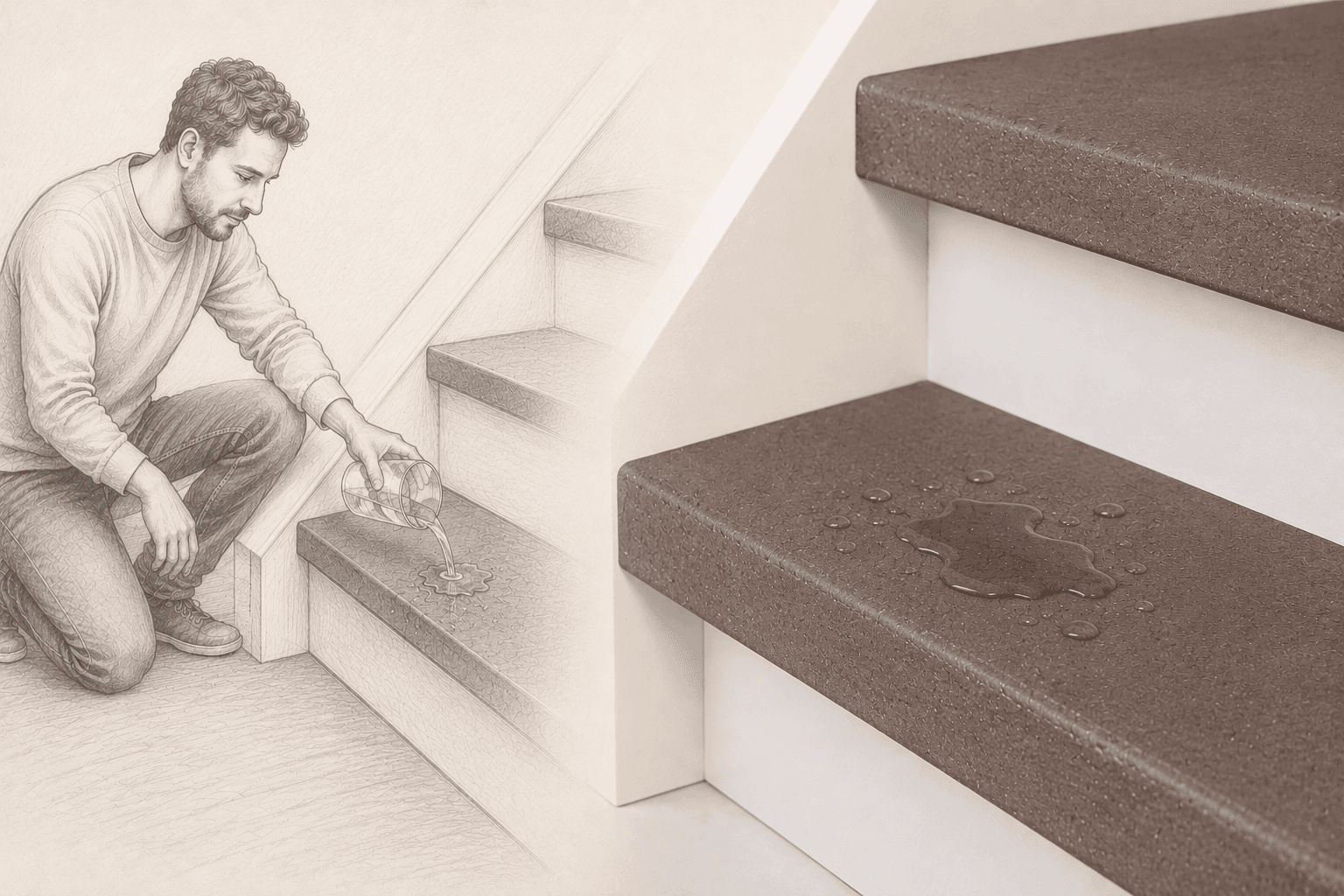
Moisture and stair finishes are not a good combination — at least, not with all materials. What exactly happens depends strongly on the system used.
Laminate and moisture
Laminate consists of an HDF core of compressed wood particles. That core is moisture-sensitive.
If moisture penetrates through the seams or the nosing — from spilled liquids, a leak or prolonged condensation — the core swells. The result: bulging treads, edges coming loose and visible deformation.
Once damaged, laminate is difficult to repair. The tread in question usually has to be replaced entirely.
PVC and moisture
PVC is naturally water-resistant. The sheet itself does not absorb moisture.
But if the adhesive bond between the PVC tread and the underlying wooden tread is not watertight, moisture can creep under the tread. That causes mould formation on the wood and the sheet coming loose.
Recycled natural stone composite and moisture
Recycled natural stone composite is mineral in composition. It does not absorb moisture the way wood or HDF does.
With correct installation — where the adhesive bond is fully covering — there is no path for moisture to get between the tread and the substrate.
In the case of a leak above the staircase or prolonged water contact, it is wise to check the connection. But the material itself does not react to moisture the way laminate does.
How do you recognise moisture damage in a stair renovation?
Look for bulging edges or corners of treads, a hollow sound when tapping the tread, visible discolouration or dark spots under the tread, a musty smell near the staircase, and visible mould on the underside or side of the tread. If a tread sounds hollow or the staircase creaks, there may be another cause — read more in renovating a creaking staircase.
What do you do in the event of moisture damage?
First remove the source of moisture — resolve the leak or moisture problem. Then let the structure dry completely. Next, assess whether the tread and the underlying structure are still intact. And finally, determine whether repair or replacement is needed.
How do you prevent moisture damage?
Wipe up spilled liquids immediately. Do not use a wet cloth that leaves too much water behind when cleaning. Regularly check the connections at pipework above or beside the staircase. And report leaks immediately — otherwise moisture damage under a tread remains invisible for a long time.
How maintenance differs per material is covered in stair renovation maintenance by material type. The broader framework can be found in stair renovation maintenance. And how the materials compare in a broader sense is covered in which material suits a stair renovation.
Have your staircase assessed
Do you suspect moisture damage to your stair renovation? A selected Omnistair installer with system training will assess the situation on site. Via omnistair.com you can request an appointment.
Frequently asked questions
No. The HDF core of laminate is moisture-sensitive. On water contact, the core can swell and deform.
The mineral material does not absorb moisture. With correct installation, moisture damage is minimal. In the event of a leak, it is wise to check the connection.
Bulging edges, a hollow sound when tapping, dark spots, a musty smell or visible mould.
That depends on the extent. Sometimes replacing a single tread is sufficient. With extensive damage to the underlying structure, more work is needed.
First remove the source of moisture. Let the structure dry and then have the situation assessed by an installer.
Read more
Related knowledge-base articles
Stair renovation maintenance — how do you keep a renovated staircase in good condition?
How do you maintain a renovated staircase? A calm overview of maintenance principles, what maintenance depends on and how a closed surface structure makes the work easier.
Read more →
Stair renovation maintenance by material type
How do you maintain a renovated staircase? Read maintenance tips per material for laminate, PVC and recycled natural stone composite.
Read more →