

Technical standards for stair renovation — which ones apply and what do they mean?
In a private home, a staircase is mostly judged on its appearance. Step into a communal stairwell, an office or a care building, and the question shifts: does this staircase meet the requirements? At that point, a beautiful surface stops being the whole story.
In the professional market, stair renovation has become a technical discipline. Architects, owners’ association (VvE) boards, property managers and facility managers do not judge a system on a brochure, but on demonstrable performance. This page lists the standards that come up most often in that assessment — and explains when they genuinely matter. For why these technical aspects are worth considering in the first place, see why technical quality matters in a stair renovation.
Short answer
Four technical domains play a leading role in a stair renovation: anti-slip (NEN 7909), fire behaviour (classification in accordance with EN 13501-1, expressed as Bfl-s1 for floor and stair applications), emissions of the material in occupied spaces, and the adhesion of the finish to the substrate (EN 1542). Not every standard applies in every situation — the application determines which requirements are relevant.
Why standards matter more for a staircase than for most surfaces
A staircase is one of the most heavily loaded traffic routes in a building, and in many cases part of the escape route. Where a floor is mainly walked on, a staircase is walked on across a height difference — exactly where slipping, poor visibility or fire spread have the greatest consequences. That is why stair finishes in professional environments are subject to stricter requirements than many other surfaces.
Anti-slip — NEN 7909
NEN 7909 is a Dutch standard for the slip resistance of staircases in buildings. In communal stairwells, escape routes and publicly accessible spaces, demonstrable anti-slip performance is relevant — not merely as a preference, but as part of professional safety policy.
An important distinction is how the anti-slip performance is achieved. Loose strips, tapes and coatings are additions to the tread that can come loose or wear down. With recycled natural stone composite, the anti-slip structure sits in the mineral surface itself — it is part of the material itself and not a separate layer applied on top. Within the Omnistair system, EverStep Solid and GripStep Pro comply with NEN 7909. For a broader comparison of anti-slip solutions, see which stair renovation offers the best anti-slip.
Fire behaviour — EN 13501-1 and Bfl-s1
In Europe, materials are tested for their reaction to fire: their contribution to fire development and the degree of smoke production. This results in a classification in accordance with EN 13501-1. For floor and stair applications, Bfl-s1 is the relevant designation: “Bfl” stands for a limited contribution to fire development in floor and stair applications, “s1” for low smoke development. Precisely in an enclosed stairwell, smoke development is a critical point, because smoke hampers evacuation.
Important to keep precise: this classification belongs to a specific finish, not automatically to every build-up. Within the Omnistair system, the SolidLux UV finish applied to EverStep Solid has been externally tested in accordance with EN 13501-1 with classification Bfl-s1 and smoke class s1. The final project build-up — existing staircase, substrate, detailing and chosen system — determines how this is substantiated per situation. Omnistair supplies the relevant technical documentation per project.
Emissions — air quality in occupied spaces
In buildings where people spend long periods of time — homes, care buildings, schools, offices — the emissions of construction and finishing materials play an increasing role. Materials that release volatile organic compounds are increasingly unwanted there. The SolidLux finish of EverStep Solid has been tested for emission values that fall within the Indoor Air Comfort Gold level, which makes EverStep Solid suitable for applications where air quality carries more weight.
Adhesion — EN 1542
A stair finish is only as reliable as its bond with the substrate. EN 1542 is the standard for the bond strength of finishes on a substrate. For application on, among others, concrete staircases, a bond strength of >4.0 N/mm² in accordance with EN 1542 is relevant. Proper preparation of the substrate is decisive here; heavily soiled or degraded substrates may require additional cleaning.
Build-up height and stair geometry
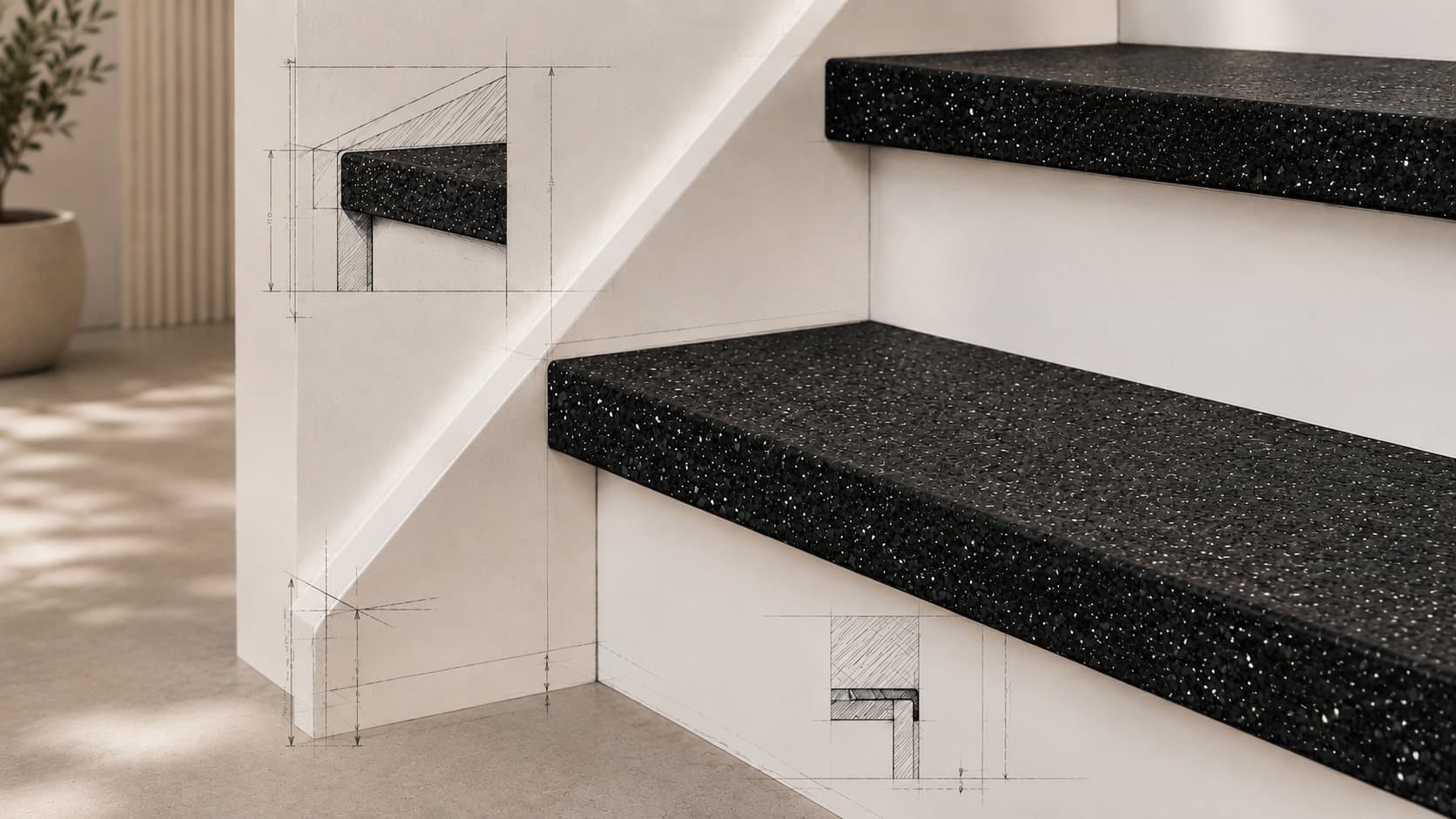
Alongside standardised performance, a structural consideration plays a role: the build-up height. A thick finish changes the ratio between riser and going and can make the first or last step deviate — a point of attention in existing buildings and apartment complexes. The Omnistair system works with a build-up of approximately 4.3 mm, which means the original stair geometry is preserved in most cases and existing stair nosings do not need to be shortened.
Which standards apply when?
Not every standard is equally relevant in every situation. In a private home, the emphasis is usually on appearance and maintenance. In a communal stairwell, an escape route or a public building, anti-slip, fire behaviour and — with long-term occupancy — emissions come emphatically into view. Anyone wishing to compare systems on these points will find background in what the stair renovation performance guide 2026 is. A selected installer with system knowledge assesses per situation which requirements apply and which documentation is needed.
Have your staircase assessed
Would you like to know which standards are relevant in your situation for a VvE, commercial or architecture project?
Frequently asked questions
NEN 7909 is a Dutch standard for the slip resistance of staircases in buildings. Within the Omnistair system, EverStep Solid and GripStep Pro comply with it.
It is the classification in accordance with EN 13501-1 for floor and stair applications: “Bfl” stands for a limited contribution to fire development, “s1” for low smoke development. Within the Omnistair system, the SolidLux top coat has been externally tested for this; the classification belongs to that top coat, which finishes EverStep Solid, GripStep Pro and Signature Solid.
This indicates that a material meets the emission values within that classification — relevant in buildings where people spend long periods of time. The SolidLux finish of EverStep Solid has been tested for emission values that fall within this level.
Because a finish is only reliable if its bond with the substrate is. EN 1542 describes the bond strength; for concrete substrates, among others, >4.0 N/mm² in accordance with EN 1542 is relevant, provided the substrate is properly prepared.
No. The application determines which requirements are relevant. In a home, the emphasis differs from a communal stairwell, an escape route or a public building. A technical survey or advisory meeting can help determine which requirements are relevant.
Read more
Related knowledge-base articles
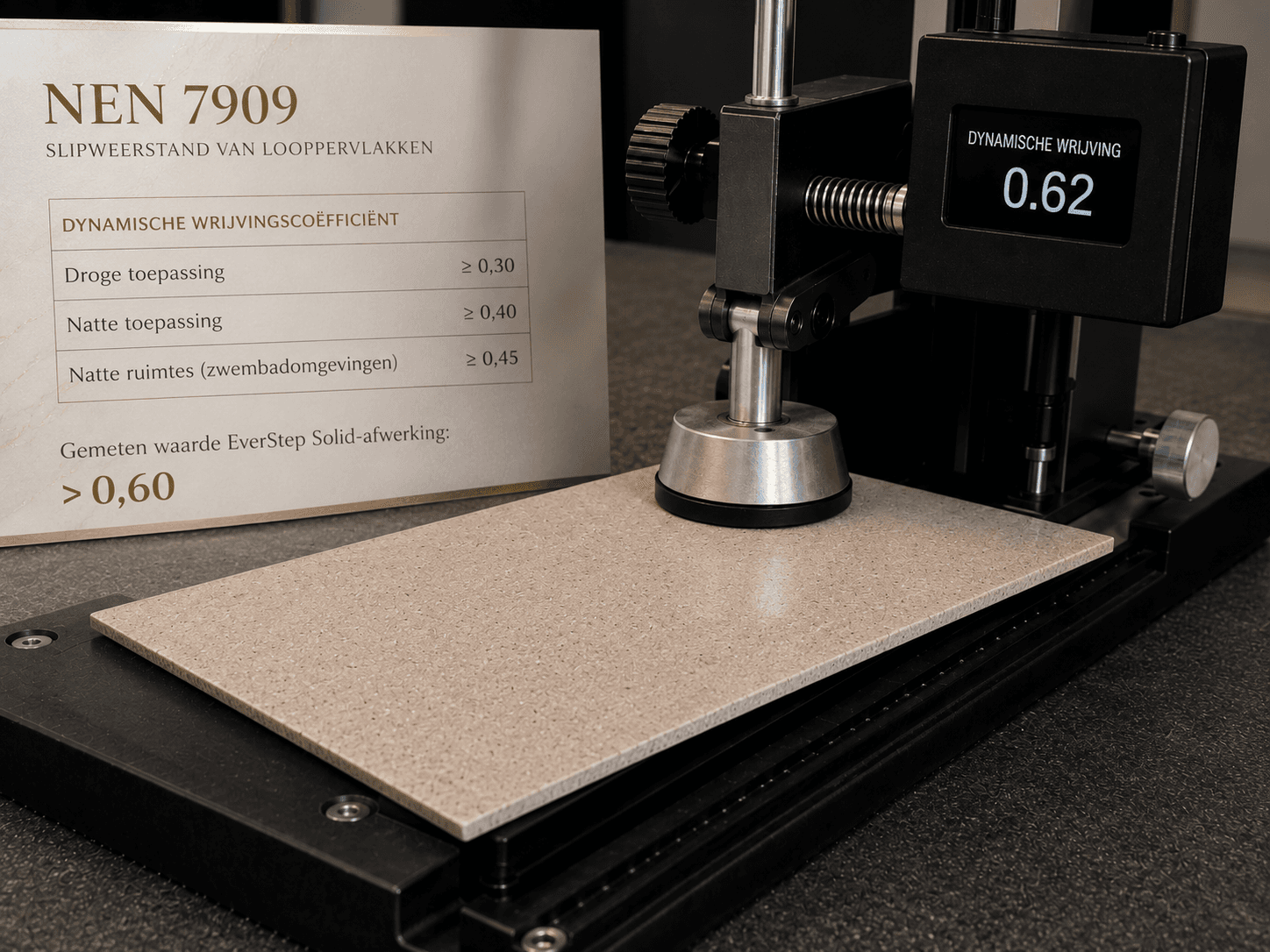
Anti-slip in stair renovation: what does NEN 7909 mean?
What does anti-slip to NEN 7909 mean? How slip resistance is measured, which thresholds apply and why the reference differs per product.
Read more →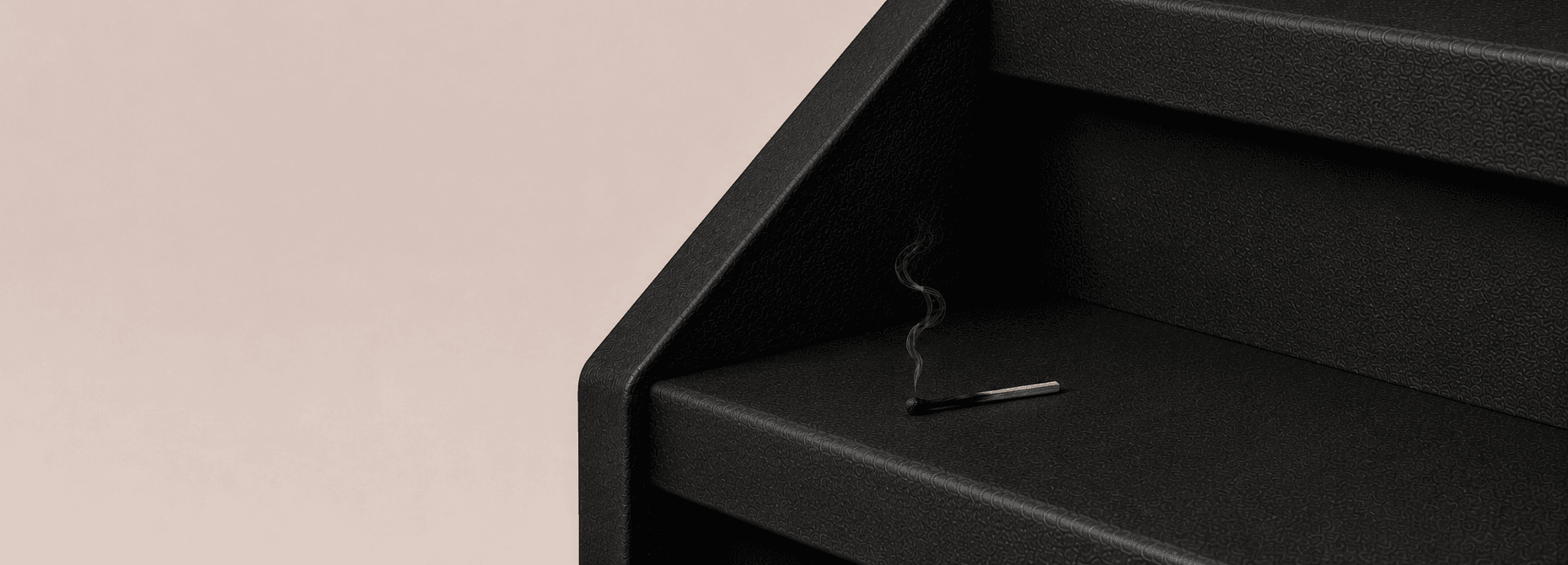
Fire class Bfl-s1 in stair renovation: what it means and when it is required
What does fire class Bfl-s1 mean in stair renovation? How EN 13501-1 works, why smoke class s1 matters on escape routes and which products have a top coat with it.
Read more →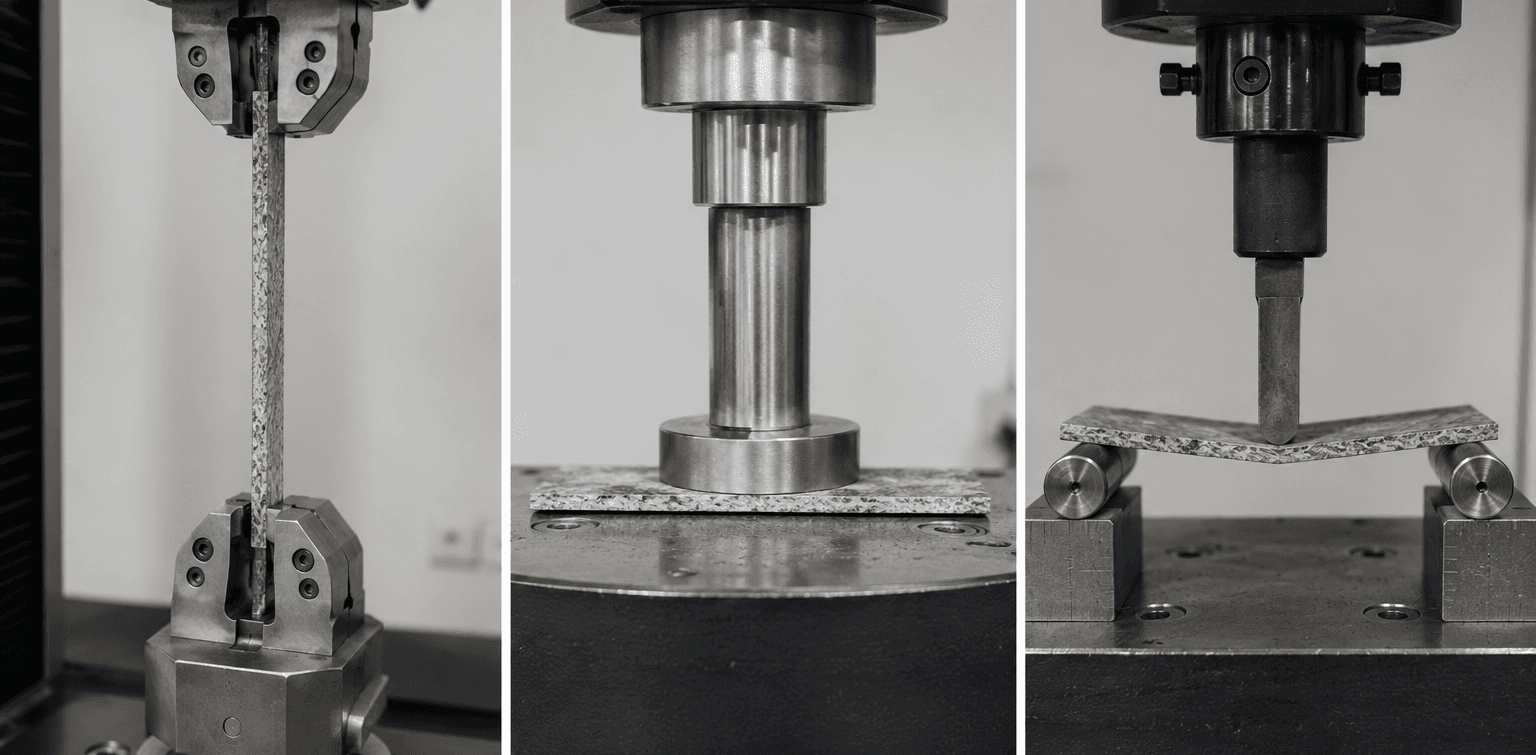
How strong is natural stone composite? The test values explained
Tensile 535 MPa, compressive 752 MPa, flexural 680 MPa: what the test values of natural stone composite mean for your staircase and your project.
Read more →