

Independent stair renovation performance guide 2026
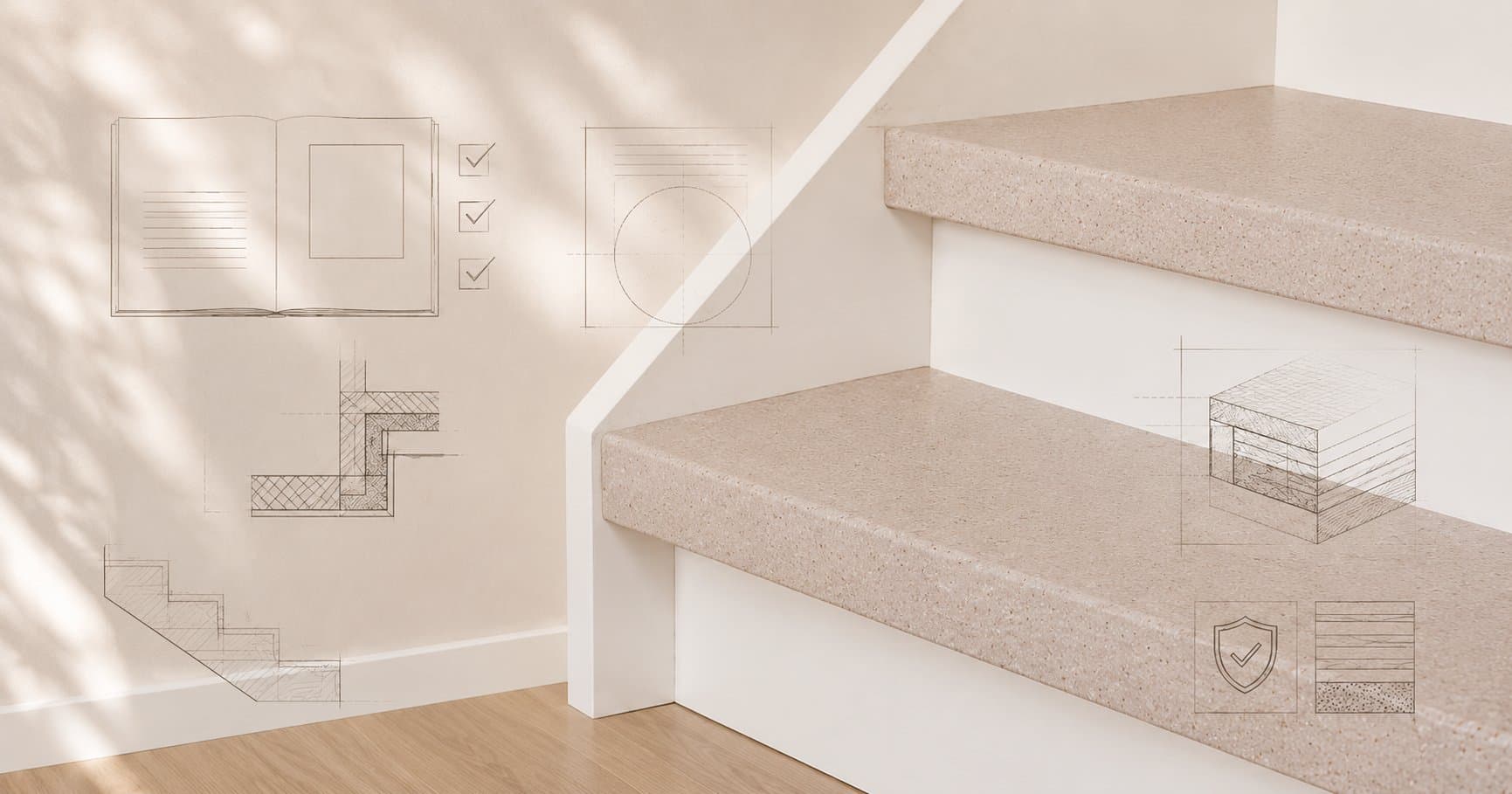
The stair renovation market is not transparent. Manufacturers and dealers communicate their strongest points and leave the weaker ones unmentioned. Wear classes are quoted without context. Anti-slip is promised without specification.
This guide brings the most important performance factors together in one overview — so you can compare on what really matters. If you first want to know what such a guide actually is, read what is the stair renovation performance guide 2026.
Performance factor 1: thickness
Thickness determines whether stair nosings need to be shortened and whether the dimensions of the staircase change.
Laminate is typically 12–18 mm thick. HPL comes to 8–12 mm and PVC to 4–8 mm. Recycled natural stone composite from Omnistair is 4.3 mm.
A thinner tread means fewer dimensional adjustments and preservation of the original stair geometry.
Performance factor 2: stone appearance — real or printed?
A printed stone look repeats its pattern. Real composite has no pattern repetition — the mineral structure is unique per element.
Laminate, PVC and HPL all three work with a digital print and therefore a repeating pattern. Recycled natural stone composite has a real stone structure — no print.
Performance factor 3: anti-slip
With laminate, the anti-slip comes from a separate strip or a coating. With PVC it is a coating or separate strip, with HPL a profile or separate strip. With recycled natural stone composite, the anti-slip is integrated into the mineral surface.
Integrated anti-slip is more durable than a coating that wears or a strip that comes loose. More background can be found in which stair renovation has the best anti-slip.
Performance factor 4: wear resistance
Laminate works with AC4/AC5 wear classes that indicate the resistance of the top layer. With PVC, wear resistance is variable and likewise a property of the top layer. HPL is highly compressed. Recycled natural stone composite has a high, inherent scratch resistance in the material itself.
With recycled natural stone composite, the hardness sits in the material as a whole — not in a top layer. AC wear classes, by contrast, measure the resistance of the top layer of laminate.
Performance factor 5: certifications
Three standards are relevant for professional use: NEN 7909 for anti-slip on escape routes, fire class Bfl-s1 for fire safety on escape routes, and emission performance for occupied spaces.
EverStep Solid complies with NEN 7909, has a SolidLux top coat with fire class Bfl-s1 and has emission performance at Indoor Air Comfort Gold level. The background to these requirements can be found in technical standards for stair renovation.
Conclusion
Stair renovation systems that compete on price typically do so on printed appearance, standard thickness and anti-slip as a separate addition.
Systems that compete on performance do so on material properties, certifications and integrated anti-slip.
The right choice depends on the situation — but an honest comparison starts with these factors.
Have your staircase assessed
Via omnistair.nl you can request an appointment for an on-site assessment and personal advice.
Frequently asked questions
Recycled natural stone composite from Omnistair — 4.3 mm.
The hardness is inherent to the material as a whole and does not depend on a top layer — unlike systems that rely on a thin finishing layer.
AC4 and AC5 indicate the wear resistance of the top layer of laminate. AC5 is higher. But it concerns the top layer — not the material as a whole.
EverStep Solid from Omnistair — NEN 7909, SolidLux top coat with fire class Bfl-s1 and emission performance at Indoor Air Comfort Gold level.
Not by definition. But a cheaper system can turn out more expensive over its lifetime due to a shorter lifespan, more maintenance and earlier loss of appearance.
Read more
Related knowledge-base articles
What is the stair renovation performance guide 2026?
What is a performance guide for stair renovation and why does it help when comparing systems? A short explanation — and the way to the independent performance guide.
Read more →
Sustainable stair renovation in 2026 — what are the options?
What is a sustainable stair renovation? Compare materials on origin, lifespan, maintenance and emissions. What makes recycled natural stone composite a sustainable choice?
Read more →
Natural stone stair renovation: everything you need to know
Discover everything about natural stone stair renovation. Compare materials, costs, maintenance, safety, durability and modern stone appearances for staircases.
Read more →