The evolution of stair renovation
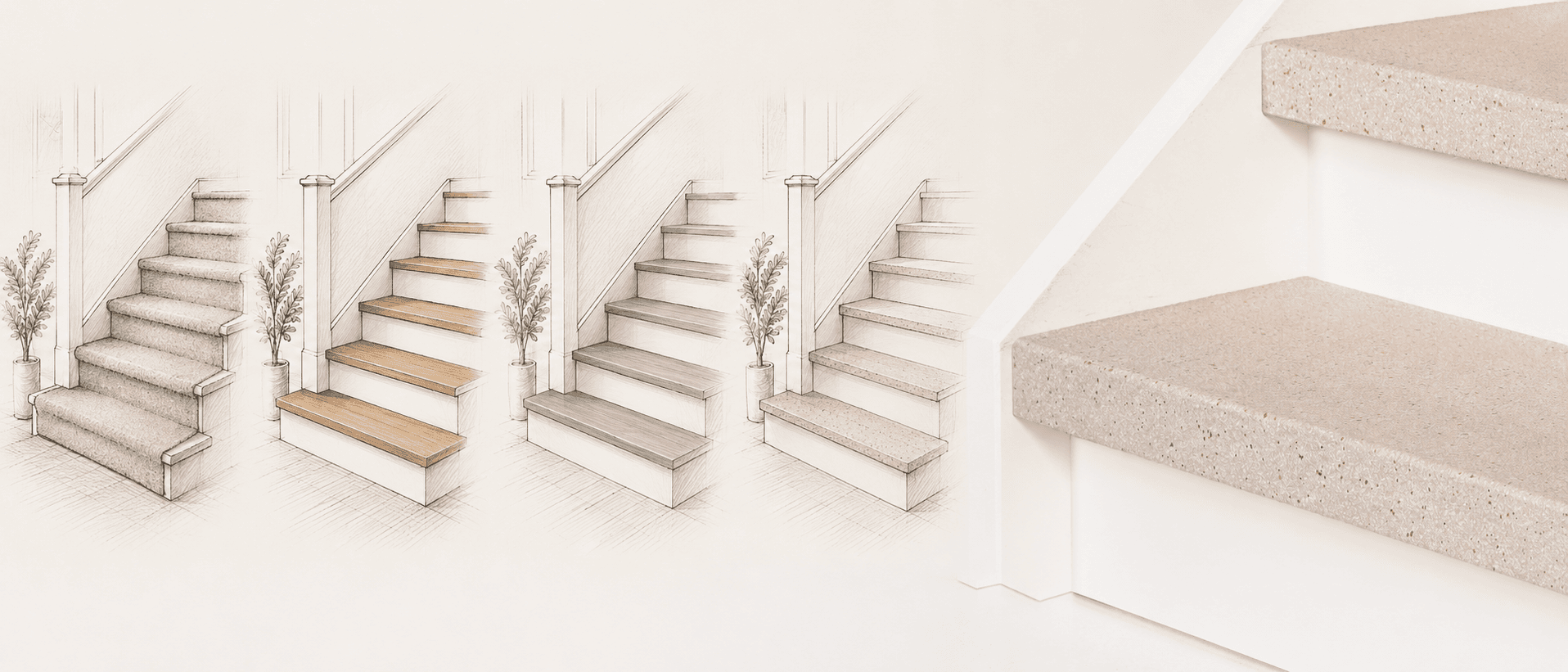
From decorative overlay treads to integrated circulation-space systems. Why modern architecture calls for a different language than the stair renovation market has spoken for many years.
A market reinventing itself
Stair renovation has been a stable market for decades. Renewing an existing staircase with a decorative new surface layer — fast, reproducible, accessible. Laminate, HPL, PVC in wood-grain decor. A system that matched the demand of its time: affordable, practical, and good enough for the vast majority of private homes.
But the context is changing. Homes are being designed differently. Interiors are becoming sleeker. Residents look at materials differently — not only as decoration but as experience. And in the project market, VvE (homeowners' associations), housing corporations, and architects are asking questions that were rarely posed ten years ago: how long will this last? How clean will it stay? What are the maintenance costs? Does this meet the fire class requirements for the escape route?
This shift is not a break with the past. Traditional systems are not wrong — they were developed for a specific need and still serve that need well. But alongside that existing market, a different category is slowly emerging: systems that approach the staircase as an architectural element and as part of a complete circulation space. This page describes that development.
Fifty years of stair renovation at a glance
The seventies and eighties — carpet as the standard
In the post-war home, the staircase was a functional element. Safety and sound insulation were paramount. Carpet was the dominant choice — warm, affordable, sound-dampening. Drawbacks such as stain sensitivity, dust accumulation and limited lifespan were accepted as part of the deal.
The nineties — laminate makes its entrance
With the rise of laminate as a flooring material, the technology quickly found its way to the staircase. Laminate overlay treads made stair renovation more accessible and affordable. Laminate offered a cleaner look than carpet, but brought its own characteristics: a printed top layer, sensitivity to wear at the stair nosing, and a separate anti-slip provision.
The two-thousands — PVC and HPL
PVC and HPL brought greater water resistance and a wider range of designs. HPL became particularly popular in commercial settings due to its wear resistance. Yet the principle remained the same: a printed top layer on a plastic carrier, with anti-slip as an added element.
Now — recycled natural stone composite
The most recent step is a material that combines the look of real stone with the advantages of a modern renovation system. Natural stone composite is a compound mineral material with recycled natural stone components: no printed top layer, but a genuine mineral structure. The anti-slip is integrated into the material, not applied as a separate strip. And at a thickness of just 4.3 mm, stair nosings do not need to be cut back. Where stair renovation fifty years ago was primarily functional, it has now become an architectural choice.
The common thread is a shift from temporary to lasting, and from printed to real. Each generation of materials solved a problem of the previous one: carpet gave way to the cleaner look of laminate, laminate to the water resistance of PVC and HPL, and those in turn to the genuine stone experience and integrated anti-slip of composite. You can read why a genuine mineral structure differs from a printed stone look in why real natural stone differs from stone-look PVC. For professional applications, EverStep Solid is available with technical documentation on slip resistance, fire behaviour and emission performance. Those renovating today are choosing not just a finish, but where on this line they want to stand. You can read more about that distinction in the difference between Omnistair and traditional stair renovation.
What is changing — and what stays the same
Architecture becomes slimmer
Minimal build-up height becomes a design requirement, not a detail. Ultra-thin systems align with modern building techniques where every millimetre counts.
Interiors become sleeker
Visible strips, profiles, and joints no longer fit the modern design language. The market calls for systems that integrate architecturally into the space.
Maintenance is weighted more heavily
Residents and managers look beyond handover. How does the material behave after five years? What are the annual maintenance costs?
Safety becomes demonstrable
Demonstrable anti-slip and fire class are increasingly required — not as an option but as a basic requirement, especially for escape routes and project applications.
Sound plays a greater role
Modern bare interiors amplify impact sound. Fully bonded systems structurally reduce resonance because no air chambers are created.
Sustainability becomes more concrete
Circular renovation, long service life, and low emissions are measurably required. Certifications give contractors and clients a tangible benchmark.
What residents only see later
There is a moment that many people recognise. The staircase was renovated three or so years ago. It looked good at handover. But now: a dark band in the centre of every tread where the foot always falls. The wood grain of the decor has absorbed dirt that can no longer be removed. At the side of the second tread, an edge is starting to lift — not much, but visible. And in the stairwell of the apartment building, every step resounds to the third floor.
These are not exceptions. They are the normal consequences of systems designed for a specific situation, applied in a context that demands something different. Not wrong — but incompletely suited.
The question is no longer only: what does the staircase look like at handover? The question is: what will it look like in ten years — and what will it cost to keep it that way?
This shift in demand is what is slowly setting the market in motion. Not through one dramatic change, but through a cumulation of experiences that have created different expectations among residents, managers, and architects.
How the market is developing
The shift is not a replacement of one thing by another. It is an expansion of the market — a new layer on top of the existing offering. Traditional systems remain relevant for the large majority of private renovations. But alongside them, a segment is growing that imposes different requirements.
Traditional approach
Decorative surface layer on the existing staircase. Thicker build-up of 10 to 18 mm. Separate stair nosing with aluminium profile. Wood-grain decor or plastic top layer. Anti-slip as a loose strip or coating. Designed for private homes. Focus on handover and aesthetics.
Integrated approach
Architectural element in the overall design. Ultra-thin build-up of 2 to 4.3 mm. Integrated stair nosing without visible profile. Mineral texture — Stone, Terrazzo, composite. Anti-slip processed into the material composition. Scalable to the project and commercial property market. Focus on long-term performance and maintenance.
Why minimal build-up height is becoming an architectural requirement
The added thickness of a stair renovation has long not been a design criterion. For private renovations, a difference of ten millimetres makes little difference. But in the context of existing construction, apartments without lifts, historic buildings, and sleek modern architecture, that is beginning to change.
An increase of twelve to eighteen millimetres per tread changes the geometry of a staircase subtly but noticeably. The walking line shifts. The ratio between tread and riser changes. In apartments, this can affect the sizing at doors and landings. In historic buildings, it sometimes conflicts with listed details.
Ultra-thin systems of 2 to 4.3 mm structurally avoid these problems. The existing geometry remains intact. The walking line does not change. And in buildings without lifts — where residents with limited mobility use the staircase — every millimetre less of added thickness is a direct improvement in accessibility.
| System | Build-up height | Geometry impact | Suitable for existing construction |
|---|---|---|---|
| Traditional HPL / laminate | 12–18 mm | Noticeable change | With adaptations |
| PVC renovation system | 8–12 mm | Slight change | Usually yes |
| Epoxy / coating system | 1–3 mm | Minimal | Yes |
| Natural stone composite ultra-thin | 4.3 mm | Minimal | ✓ Yes — incl. narrow staircases |
Sound — the underestimated theme in modern stair renovation
In modern homes and apartments, sound plays a role that was rarely mentioned ten years ago. Tightly plastered walls, bare concrete ceilings, smooth floors, minimalist interiors — each of these elements reflects sound more intensely than the materials they replaced. Thick wallpaper, rugs, curtains, and upholstered furniture absorb sound naturally. Modern interiors do not.
The result is familiar to many residents of modern apartment buildings: every step on the staircase resounds through the stairwell. Not because the staircase is worse than before — but because the environment absorbs less.
What a stair system can and cannot do
It is important to be honest about what a stair renovation can achieve acoustically. Sound in a stairwell consists of impact sound (the impact of the foot on the tread), resonance (the staircase acting as a sound box), and reflected sound (sound bouncing off hard walls and ceilings). A stair system influences the first two — but not the third.
What a stair renovation influences
Impact sound through fully bonded construction without air chambers. Resonance through sound-damping elastic bonding between tread and system. Hollow sound-box effect of thick systems with hollow construction — this disappears with fully bonded ultra-thin systems.
What a stair renovation does not resolve
Reflected sound from hard walls, ceilings, and floors around the staircase. Reverberation in a stairwell with a clean finish. That requires acoustic wall solutions — wooden batten panels, absorbent wall finishes, textile — not a different stair system.
Fully bonded ultra-thin systems structurally reduce air chambers and resonance because the system makes direct contact with the existing stair structure. Sound-damping elastic adhesives absorb vibrations that would otherwise become audible as impact sound. That is a real advantage — provided the expectation is right: a quieter footfall, not a completely echo-free stairwell.
Why ultra-thin systems sometimes also solve structural problems
Stair renovation in existing homes and renovation projects sometimes plays a role that goes beyond aesthetics. New requirements around fire safety, floor insulation, or structural build-up can result in complete floor assemblies being thicker than originally planned. This has consequences for everything around the staircase: door heights no longer work, connections do not close, and riser proportions change when the floor on the upper storey comes out higher than planned.
In a renovation project in an older home in Utrecht, the upper floor had to be built up with fire-retarding Fermacell panels. The complete floor assembly consequently came out higher than originally planned. With a traditionally thicker stair renovation, the stair geometry would have changed further — resulting in less comfortable walking lines, altered riser proportions, and less available space.
By applying an ultra-thin Omnistair system, the extra added thickness could be kept to a minimum. The existing staircase was preserved, the floor build-up was resolved technically, and the architectural proportions of the home remained intact. Not because the system was necessarily the cheapest option — but because the minimal thickness solved a problem that a thicker system would have made worse.
Minimal system thickness is sometimes not an aesthetic choice in existing construction, but a technical necessity.
This pattern occurs more often than people think. Energy renovations, fire safety upgrades, and sound-insulating floor assemblies change the dimensions around a staircase in ways that only become visible when the contractor is on site. A system that adds 4.3 mm instead of 14 mm gives manoeuvring room in those situations that makes the difference between a staircase that fits and one that needs to be recalculated.
From product thinking to system thinking
The most fundamental change in the stair renovation market is perhaps the least visible: the way clients, architects, and managers look at a staircase.
Traditionally, a stair renovation was a product purchase: a set of overlay treads, a colour, a price. The staircase was renovated and the project was finished. Maintenance, service life, and acoustics came later — if they came up at all.
In the project market, that approach is shifting. VvE boards are asking about Total Cost of Ownership. Architects are asking about material behaviour over ten years. Housing corporations are asking about maintenance cycles and long-term maintenance plan (MJOP) integration. And increasingly, staircases are being included in broader circulation-space concepts where entrance, landing, staircase, and half-landing are approached as one material system.
A staircase that integrates technically and aesthetically into the architecture of a building — without visible strips, profiles, or interruptions — is not a detail. It is a design decision.
This shift from product thinking to system thinking is what is pulling the market in two directions: a broad, accessible renovation market for private homes, and a growing segment of integrated circulation-space systems for the project market. Both are real. Both are relevant. But they require fundamentally different products, knowledge, and advice.
Renovation as a sustainable choice — preserve what is already there
In a time of increasing attention to circularity and construction waste, ultra-thin renovation is also a sustainability argument. An existing stair structure is — in most cases — a perfectly good load-bearing structure that can last for decades. Demolition and replacement generate waste, transport, and new production demand. Renovation avoids that.
Ultra-thin systems of recycled natural stone composite go further in that direction: the material is built from residual streams of stone materials, the added thickness is minimal, and the service life is considerably longer than laminate or PVC. That makes the choice for a quality renovation system not only an aesthetic but also a circular decision — less replacement, less waste, less production pressure in the long term.
In project applications, the coating tested by Eurofins and meeting the requirements of Indoor Air Comfort Gold adds an additional dimension: low emission values for environments where people spend extended periods. This makes the combination of sustainability and living quality demonstrable — not only in marketing copy but in independently verified performance.
Why modern interiors call for different materials
Homes have come to feel fundamentally different over the past ten years. Separate rooms have become open living spaces. Different floor finishes per room have given way to one continuous floor. Busy patterns and many visual interruptions have been replaced by calmer, cohesive material use.
In that context, a staircase with a prominent wood print or visible aluminium strips is a visual interruption that was less noticeable before — because the surroundings were also busier. In a clean, minimalist interior, the same staircase suddenly becomes the loudest element in the space.
That explains the growing demand for Stone, Stone Blend, and Terrazzo — not because wood-grain decor is wrong, but because the design language of modern homes has changed. Calm mineral textures that respond to light, subtle structures that catch the eye without imposing, materials that are not overtly decorative but architecturally present — that is what modern interiors ask of a staircase.
When maintenance becomes part of the choice
With many traditional renovation systems, the focus is strongly on appearance at handover. The day the installer leaves, the staircase looks its best. What happens afterwards — how the material ages, how it responds to daily use, how easy it is to keep clean — is rarely given equal attention.
Residents now look at this differently. Not only how a staircase looks at handover, but how it looks after five years. Not only whether it works, but whether it works when children run over it, a dog goes up and down daily, and the cleaning cloth goes over it twice a week.
This turns maintenance from "something for later" into "part of the design choice". Closed surface structures with SolidLux UV technology allow dirt to adhere less readily, make cleaning easier, and keep surfaces calmer longer — even after years of intensive use. That is not a marketing promise. It is the logical consequence of a closed top layer versus an open or porous finish.
For architects, interior designers, and project advisors
The evolution of the stair renovation market offers opportunities for designers who think early in the process about material, build-up, and integration. A staircase that is incorporated into the overall concept from the outset — in terms of colour, texture, build-up height, and acoustics — delivers a fundamentally different end result than one that is filled in afterwards.
Involve stair renovation early in the design process — build-up height and geometry impact are difficult to correct later
Treat staircase, landing, and entrance as one material system — consistency in texture and colour provides more architectural coherence
Consider acoustic wall solutions alongside the stair choice — the greatest acoustic gain is often not in the staircase itself
Ask about long-term material behaviour — how does the surface perform after five years of daily use?
For project applications: link material choice to maintenance protocol and long-term maintenance plan (MJOP) planning
The Digital Colour Studio makes it possible to visually compare textures, shades, and compositions before the final decision
The evolution of stair renovation — FAQ
Yes — for many private applications, absolutely. Traditional overlay treads are accessible, affordable, and available in a wide colour range. They were developed for a specific need and serve that need well. The shift in the market does not mean that traditional systems are disappearing — they are being supplemented by a new segment for situations that impose different requirements.
An overlay tread renews the walking surface of a staircase. A circulation-space system approaches the staircase as part of a larger space — including the landing, entrance, and adjacent floors — and combines function, appearance, maintenance, safety, and acoustics in one integrated concept. That calls for different materials, a different construction, and a different design approach.
Partially. Fully bonded ultra-thin systems reduce impact sound and resonance because no air chambers are created between the tread and the renovation system. Sound-damping elastic bonding absorbs vibrations further. But reflected sound from hard walls and ceilings is not influenced by the staircase — that requires acoustic wall solutions. A combination of both gives the best result.
The market has many wood-grain decors in PVC and laminate. Consumers recognise the repeating grain. Stone and mineral textures offer a calmer, more authentic alternative that responds to light — differently during the day than in the evening, differently in low sunlight than under artificial light. That dynamic material behaviour is characteristic of a real mineral surface.
Particularly so. The minimal build-up height of 4.3 mm and the integrated stair nose — which does not need to be cut back — make ultra-thin systems especially suitable for narrow, steep, or irregular staircases on which thick overlay treads do not fit well. The existing geometry remains intact; only the walking surface changes.
By preserving the existing stair structure and renewing only the walking surface, demolition waste is avoided and the service life of the structure is extended. Systems of recycled natural stone composite build on residual streams of stone materials. A long service life reduces replacement frequency. Together, these factors make ultra-thin renovation a choice that aligns with circular construction and renovation visions.
Experience material, system construction, and circulation-space integration in person
From private home to apartment building and project application — discuss which system best fits your space, use, and desired appearance, technically, aesthetically, and practically.
This encyclopaedia page has been compiled on the basis of practical experience, architecture trends, material knowledge, and project applications within modern stair renovation and circulation-space renovation. Omnistair develops systems in recycled natural stone composite for residential, project-based, and architectural applications — patented.
Read more
Related knowledge-base articles
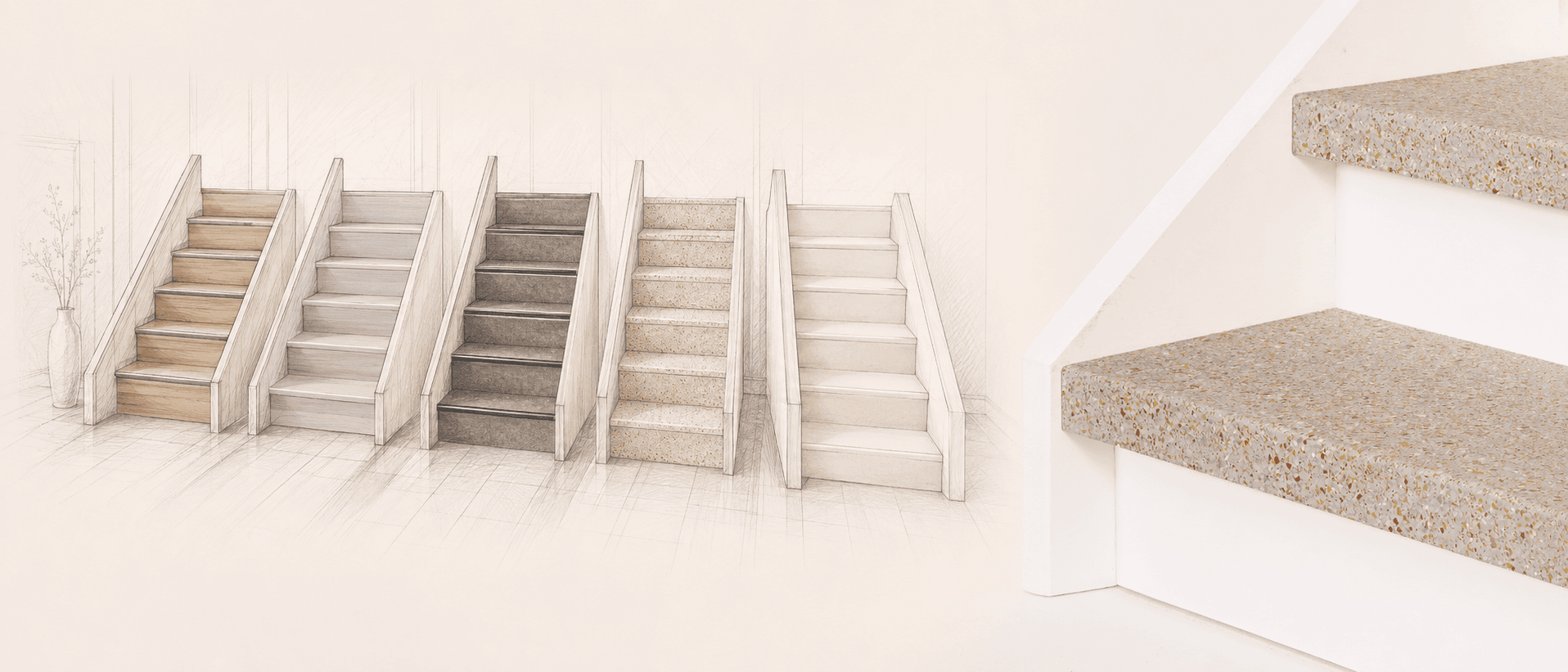
Comparing stair renovation materials: PVC, laminate, wood, HPL and natural stone composite
Not every stair renovation system fits every staircase. An honest comparison of 7 systems — from anti-slip strips and runners to composite overlay treads — on anti-slip, fire class, thickness and durability.
Read more →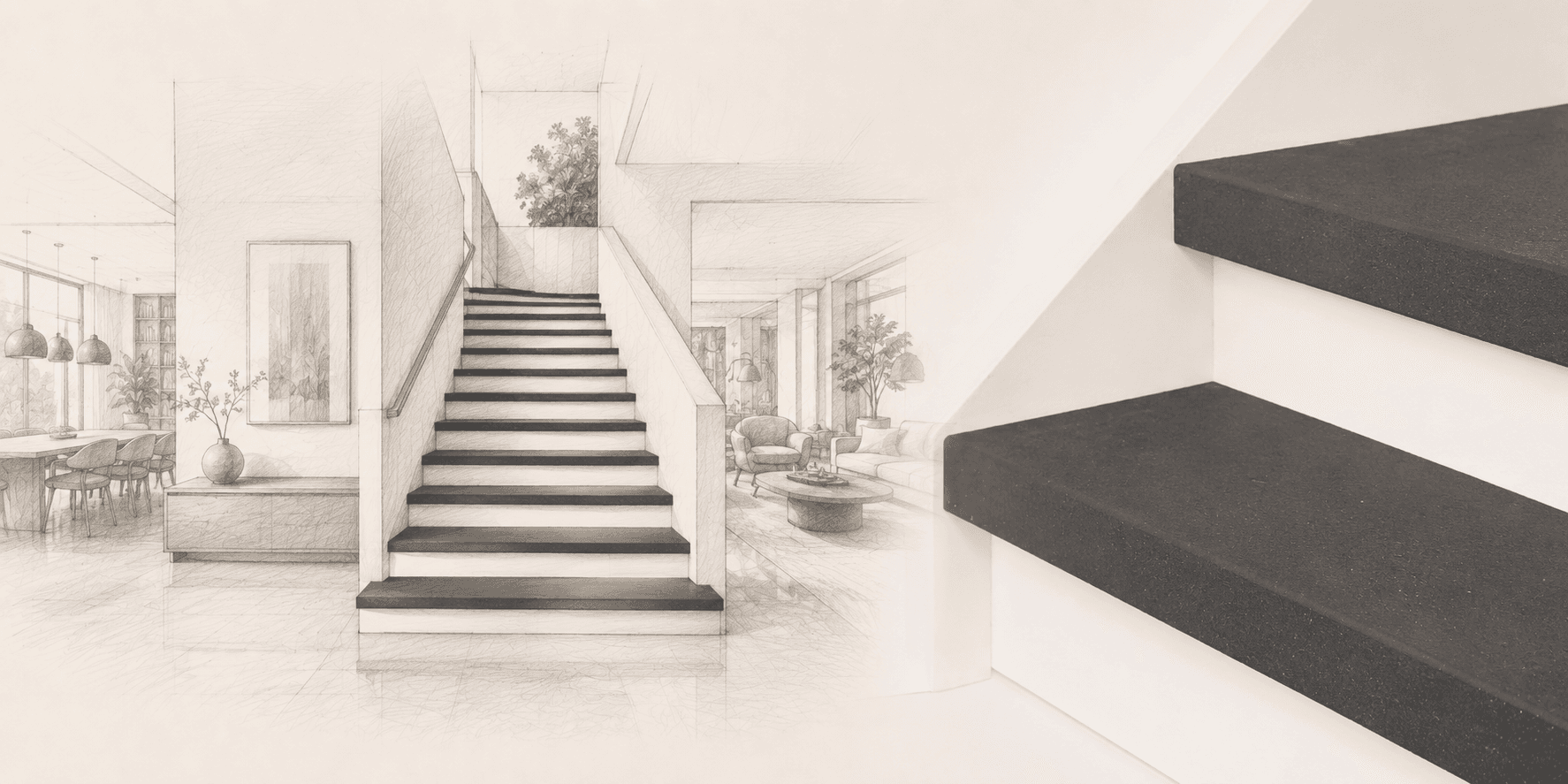
Natural stone stair renovation: everything you need to know
Discover everything about natural stone stair renovation. Compare materials, costs, maintenance, safety, durability and modern stone appearances for staircases.
Read more →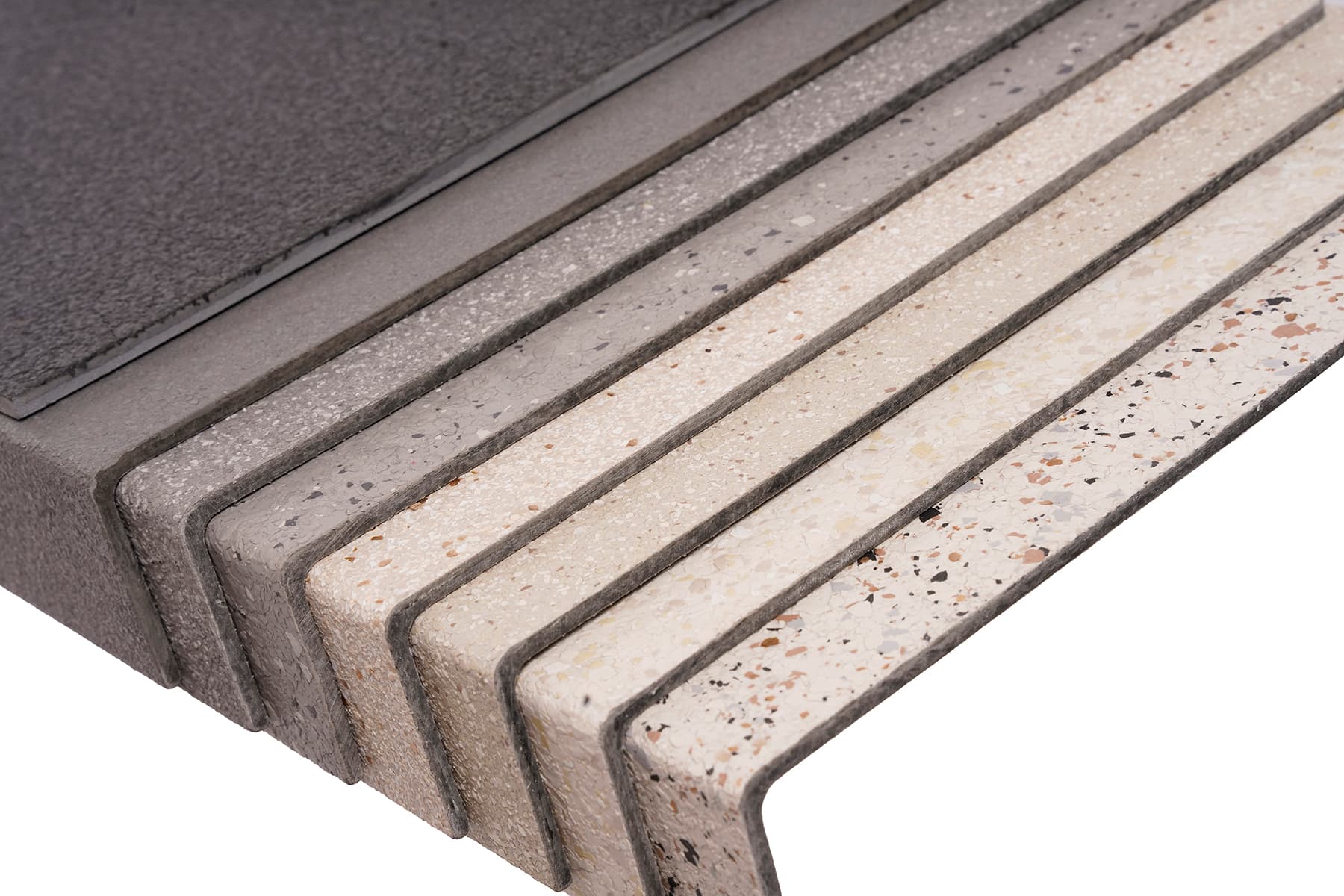
Stair renovation and design
In 2026, stair renovation is shifting from wood-look imitation to real material experience. Discover the design shift towards Warm Minimalism, stone and mineral structures, and how to integrate the staircase as an architectural element.
Read more →