

Comparing stair renovation materials: PVC, laminate, wood, HPL and natural stone composite
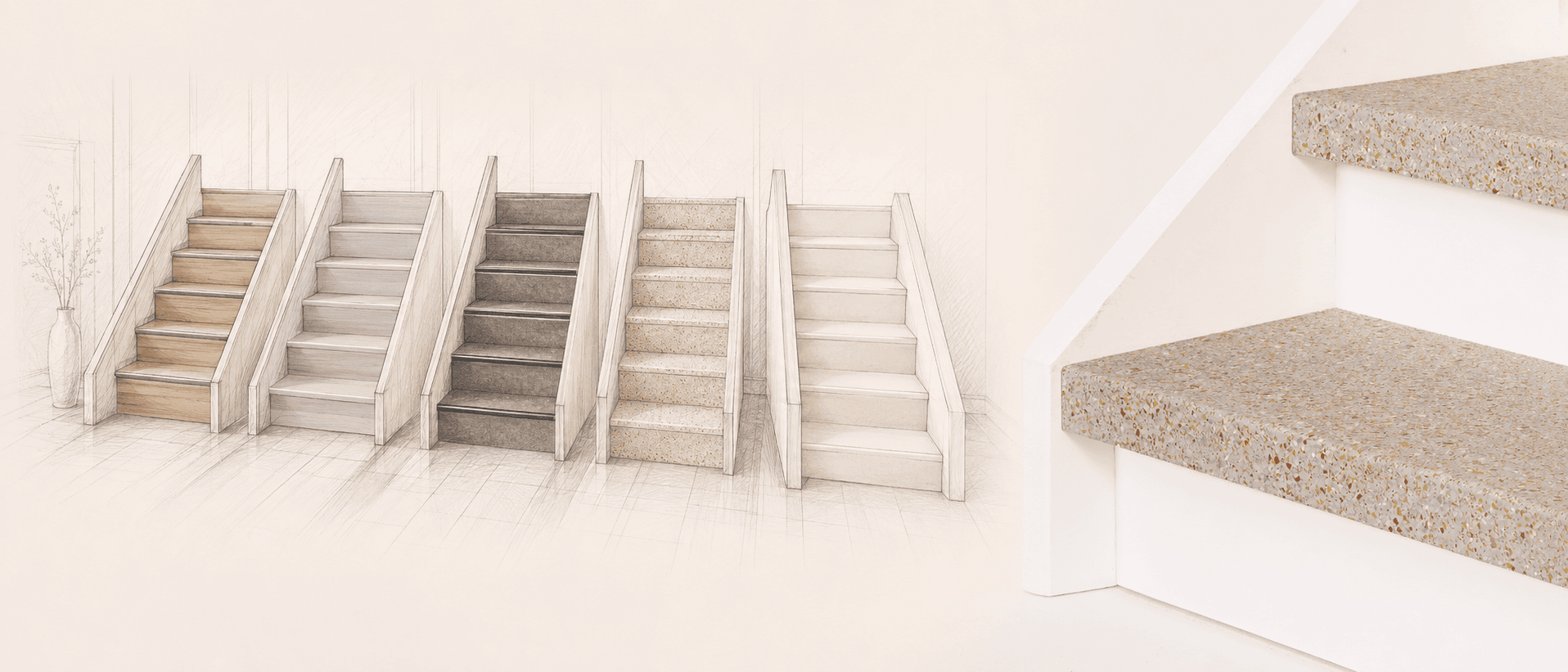
Most people start a stair renovation with one question: what does it cost? Only later — sometimes only after a choice has been made — do the questions that really matter arise. How long will it last? Does the stair nosing need to be shortened? What happens when someone walks over it in socks? Or a dog? Or an older resident who needs the handrail just a little too much?
Several material categories exist for stair renovation: carpet, wood, laminate and HPL, PVC, coatings and mineral finishes, and natural stone composite. Natural stone composite is a compound mineral material with recycled natural stone components. Omnistair uses this material for the ultra-thin EverStep overlay treads.
Each of these systems has its own characteristics, limitations and field of application. But those limitations are rarely found in the brochure — advertising focuses on benefits. And it's precisely the choice that costs the most afterwards — a treatment that wears out after three years, a system that damages the stair nosing, or laminate that is sensitive to moisture — that could have been avoided beforehand.
This page provides an objective overview of all common stair renovation systems. Not to sell a product, but to help you make a choice that suits your staircase, your use and your long-term expectations.
What makes a fair comparison?
Comparison criteria
Material and durability — what is the expected service life under daily use?
Installation — is professional installation required, or is self-assembly possible?
Stair nosing — does the stair nosing need to be cut back, or does the system fit directly over it?
Anti-slip — is grip integrated into the system, or added as a separate element?
Maintenance — how does the system behave with daily use, moisture, and wear?
Suitability — for residential, utility, or public buildings?
Appearance — which materials and finishes are available?
Which stair renovation systems exist?
There are more systems than most people realise — and the differences go beyond price or appearance alone. The choice affects how the staircase feels after five years of daily use, whether a VvE (Dutch homeowners' association) is liable in the event of a fall, and whether an installer needs to cut back the stair nosing before starting. Below is an overview of the most common systems, from simple to complex.
1. Anti-slip strips and loose profiles
Anti-slip strips are often the first response to a staircase that is too slippery — a quick, inexpensive solution that can be applied independently. They are fitted per tread as a loose strip at the stair nosing or across part of the walking surface, available in rubber, aluminium, and plastic. They do not form a complete tread replacement, but an additional safety measure. In practice they work — until they stop doing so. A loose strip on a busy staircase is not merely unsightly, but more dangerous than having no strip at all.
Advantages
What this system does well:
Limitations
What to keep in mind:
2. Carpet and runners
Carpet on the staircase was for decades the standard in Dutch homes — warm, quiet, and comfortable for bare feet. But anyone placing a carpeted staircase in a modern interior quickly notices that the surroundings have moved on. Carpet also demands maintenance that many people underestimate: the stair nosing wears fastest, stains are difficult to remove completely, and damp conditions — a wet umbrella, a dog that has just been outside — leave marks. A classic solution whose best days in most homes are behind it.
Advantages
What this system does well:
Limitations
What to keep in mind:
3. Laminate and vinyl overlay treads
Laminate overlay treads are placed as ready-made shells over the existing tread and are widely available as a DIY renovation. They look attractive in photographs. In the showroom too. But a staircase is not a floor. A floor bears weight; a staircase bears weight and shear force — every step pulls the stair nosing forward. Laminate is not inherently built for that. Moisture sensitivity, limited wear resistance at the stair nosing, and the need to cut back the existing stair nosing are limitations that only become visible after the staircase is finished.
A related variant is HPL (High Pressure Laminate): more wear-resistant and colour-fast than standard laminate and widely used in office environments, but with the same fundamental build-up — a printed top layer on a carrier, with anti-slip as a separate addition.
Advantages
What this system does well:
Limitations
What to keep in mind:
4. Ceramic tiles and natural stone
Tiles give a staircase a durable, low-maintenance finish with a high-end appearance — provided the installation is correct. And that is precisely the challenge. Tiling a staircase requires a specialist craftsman, a load-bearing substructure that can support the weight, and carefully thought-out grouting. Grout joints are not only an aesthetic matter: they trap dirt, are difficult to keep clean, and under intensive use become a wear point. Additionally, staircases are structurally prone to minor settlement that can crack tiles. On narrow or old staircases the system is in most cases simply not applicable.
Advantages
What this system does well:
Limitations
What to keep in mind:
5. Coating systems
With a coating treatment, the existing tread surface is treated with a liquid layer — from polyurethane to epoxy or specialised stair coatings. The appeal is understandable: no new materials, relatively quick to apply, and considerable freedom in colour and texture. But service life depends heavily on two factors that are difficult to control: the condition of the existing substrate and the quality of the application. At the stair nosing — the most heavily loaded point of every tread — wear in coatings typically becomes visible first. Repair is always visible as a patch, never as new.
Advantages
What this system does well:
Limitations
What to keep in mind:
6. Overlay treads in recycled natural stone composite
This is a relatively new category that has grown strongly in recent years — for good reasons. Ultra-thin treads in recycled stone composite are placed as a thin shell directly over the existing tread, including the stair nosing. No cutting required. The load-bearing structure of the staircase remains fully intact; the system only adds a new walking surface.
What distinguishes this ultra-thin stone system technically is the combination of extremely low thickness (4.3 mm), high mechanical strength — comparable to certain types of stone — and low weight relative to solid materials. Anti-slip is not present as a separate element, but is integrated into the surface structure of the tread itself: the grip lies in the colour pigments and material composition. This also means that the structure does not wear away with daily use as a coating would — the grip is in the material, not on it. In documented variants this extends to NEN 7909 level — the highest anti-slip standard for professional use, including a SolidLux top coat with fire class Bfl-s1 for applications in public buildings.
That the stair nosing never needs to be cut back is not only practical but also structurally significant: the construction of the staircase remains unchanged. No joints that begin to pull. No connections that come loose after three years. And for staircases that are loaded daily for years by children, pets, wet trainers, or residents who need the railing a little more firmly than before — that makes a measurable difference.
Advantages
What this system does well:
Limitations
What to keep in mind:
7. Completely new staircase
A completely new staircase is the most invasive — and most expensive — solution. The existing structure is removed and replaced with a new one. This brings disruption: dust, construction time, and in most cases damage to the immediate surroundings of the staircase. In practice this is only worthwhile when the load-bearing structure is structurally compromised, the stair shape fundamentally needs to change, or a complete renovation is already underway. Anyone who has a sound load-bearing structure — which is the case for most staircases in Dutch homes — virtually never needs a new staircase.
Advantages
What this system does well:
Limitations
What to keep in mind:
Systems side by side
The table below compares the most decisive characteristics of each system at a high level.
| System | Service life | Stair nosing cutting | Anti-slip integrated | Utility / public | Maintenance |
|---|---|---|---|---|---|
| Anti-slip strips | ✗ 2–5 years | ✓ Not required | ✗ Partial | ✗ Limited | Low |
| Carpet / runner | ✗ 5–10 years | ✓ Not required | ✗ Texture only | ✗ No | Intensive |
| Laminate / vinyl | 8–15 years | ✗ Often required | ✗ No | ✗ No | Low–moderate |
| Ceramic tiles | ✓ 20–40 years | ✗ Adaptation required | ✗ No (separate profile) | ✓ Possible | Low |
| Coating system | ✗ 3–10 years | ✓ Not required | ✗ Dependent | ✗ Limited | Moderate |
| Natural stone composite overlay treads | 25+ years | Never required | Fully integrated | Demonstrable | Low |
| New staircase | Depends on material | N/A | Depends on design | Possible | Depends on material |
Data based on general market overview. Individual products and installations may vary.
A deeper, independent comparison can be found in the independent stair renovation performance guide 2026.
How a small choice has major consequences
Imagine: you have a 1970s mid-terrace house with a narrow wooden staircase. The treads are still solid, but the finish is worn. You want something that looks good, feels safe — including for your mother who stays regularly — and that you won't need to think about for the next twenty years.
A laminate installer advises you to have the stair nosing cut back. That costs extra and is irreversible. A tiler indicates that the subfloor is too light for ceramic tiles. A coating company offers a nice colour — but cannot provide an anti-slip classification and gives two years' warranty on the work.
You ultimately choose the system that fits without cutting back, has certified anti-slip, and is installed by a specialist who finishes the same day. No demolition disruption. No weeks of waiting. No doubt afterwards.
The right choice in stair renovation is rarely the cheapest option upfront — but almost always the cheapest over the long term.
Why the stair nosing is so decisive in choosing a system
Many systems require that the stair nosing — the front edge of the tread — be sawn or cut back before a new tread can be placed. This is an irreversible intervention in the structure of the staircase. And that sounds more technical than it feels: anyone who has their existing stair nosing cut back afterwards has less room for correction, less bearing surface for the new tread, and a connection that is vulnerable to temperature fluctuations and shrinkage.
In addition to the extra labour costs, cutting back also brings risks: the joint between the new tread and the existing stair nosing can come loose over time, show visible seams, or shrink. On narrow and old staircases — where the stair nosing is often already small or fragile — this risk is greater than on a modern, wide staircase.
Systems that fit directly over the stair nosing — without cutting — preserve the integral construction of the staircase and minimise the risk of long-term problems.
This is also why narrow staircases are simply out of reach for many systems: the dimensions do not fit, the stair nosing is too irregular, or the structure is too fragile for the intervention the system requires. Systems that do work in these conditions are scarce — and their advantage lies not only in the end result, but in what they do not do to the staircase.
Which system suits which situation?
| Situation | Most suitable system | Reason |
|---|---|---|
| Home, normal load | Composite overlay treads or laminate | Good balance between appearance, cost, and service life |
| Home, narrow or old staircase | Ultra-thin composite overlay treads | No cutting required, fits atypical treads as well |
| Elderly / safety priority | Integrated anti-slip composite | Certified grip across full walking surface including stair nosing |
| Apartment complex / VvE | System R11 / Bfl-s1 (top coat) | Demonstrable performance, liability, intensive use |
| Utility / care environment | System NEN 7909 / fire class (top coat) | Statutory and project-specific requirements |
| Public building | NEN 7909 certified + Bfl-s1 (top coat) | Only systems with access to public applications |
| Budget renovation, temporary | Anti-slip strips or laminate | Lowest cost, easy to execute |
What a staircase really goes through
A staircase is walked on an average of forty to sixty times per day. These are not theoretical loads — they are children running upstairs in wet trainers, residents descending in the dark early in the morning, a dog that knows to walk exactly in the middle because the sides are slippery, or a guest who misses the last step because it is slightly narrower than the rest.
In apartment complexes there is something else to consider. The staircase is shared. Twenty, thirty, sometimes fifty residents per day. Shopping bags. Prams. People in a hurry. And a VvE board that is liable if something goes wrong — but outsources cleaning to a company that mops the stairs wet every week.
It is precisely those conditions for which a stair renovation system is ultimately designed. Not the showroom. Not the photograph. The staircase on an ordinary Tuesday morning, at seven o'clock, with someone who is in a hurry.
Systems that hold up well under those conditions have three things in common: grip that does not clean away, a surface that can be kept clean without the texture disappearing, and a construction that does not begin to move when the load continues for years.
For architects, VvE managers, and project-based applications
In project-based stair renovation, appearance and price are not the only factors. Liability, intensive daily use, and regulatory requirements demand that systems deliver technically demonstrable performance.
Always request demonstrable anti-slip classification — not merely "anti-slip" as a commercial term.
Verify whether the system has fire classification Bfl-s1 or higher for public use.
Assess wear resistance based on material class (hardness, compression values), not only on warranty text.
Consider future ease of repair — can a single tread be replaced?
Ask whether the system can be combined with existing regulations (Bbl, NEN guidelines).
Comparing stair renovation systems — FAQ
Systems in composite natural stone and ceramic typically offer the longest service life. Ceramic, however, requires specialist installation and a load-bearing substrate. Composite overlay treads combine long service life with a lighter material and simpler installation.
Not with all systems. Laminate and many off-the-shelf overlay treads do require it, because otherwise the nose protrudes too far and the system will not close properly. Ultra-thin systems — such as composite overlay treads at 4.3 mm — are specifically designed to fit directly over the stair nose without any modification to the existing structure. That is not a minor detail: cutting back the stair nose is irreversible and increases the risk of long-term problems.
An overlay tread is a physical element — a thin shell — placed over the existing tread. A coating is a liquid layer applied to the existing surface that hardens in place. Overlay treads generally offer a longer service life and more consistent performance because the material itself forms the wear layer, rather than a top coat applied to a substrate you cannot fully control.
For a VvE (Dutch homeowners' association) or apartment complex, certified anti-slip performance (R11 or NEN 7909) and fire classification (minimum Bfl-s1) are increasingly required in practice — not only to comply with regulations, but also for liability reasons. Not all systems meet these classifications. Always ask for official test reports, not just commercial terms such as "anti-slip" or "fire-safe".
Almost never — unless the load-bearing structure has been structurally compromised or the stair layout needs to change fundamentally. In virtually all other cases, renovation with a quality system delivers an equivalent or better result at a fraction of the cost and without the disruption of demolition. Most staircases in Dutch homes have a perfectly sound structure that will last for decades more.
That depends strongly on the system. Older or coarser anti-slip solutions have a rough relief where dirt can accumulate. Modern integrated systems — where grip is embedded in the material composition — are generally just as easy to clean as a flat surface. The texture is subtle, not industrial.
The most decisive factors are: the width and condition of the existing staircase, the intensity of daily use, the presence of children, elderly people, or pets, and any certification requirements. A consultation on-site typically provides more clarity in ten minutes than a week of searching online. A good installer looks not only at which system is the most attractive, but which system is the right fit.
Why the system determines the choice — not the material alone
Many stair renovations fail not because of the material, but because of the choice of a system that does not suit the situation. A stair nosing that was cut back and then begins to pull. A coating that detaches from an old wooden tread that moves just slightly more than expected. Laminate that turns out to be sensitive to moisture. Each of those problems was predictable — if the right questions had been asked beforehand.
Omnistair grew from that experience. After more than 25 years of working with stair finishes — from epoxy and synthetic resin to bespoke installations — it became clear that the biggest bottleneck was not the material, but the system around it. Too few skilled tradespeople, too labour-intensive, too dependent on a perfect substrate. The answer was an overlay tread system in recycled stone composite that works without compromising the existing structure.
No cutting back. No adaptation of the stair nosing. No heavy intervention. And for the most demanding applications: with demonstrable performance for anti-slip, fire classification, and indoor air quality — so that VvE (Dutch homeowners' associations), housing corporations, and public buildings can be served where other systems fall short.
Within the Omnistair range, three systems are available, each tailored to a specific field of application:
EverStep
Ultra-thin overlay treads in Stone and Terrazzo. No cutting, direct installation, wide colour collection for every living style.
EverStep Solid
NEN 7909 demonstrable anti-slip and a SolidLux top coat with fire class Bfl-s1. The only system with this combination.
Signature
Complete stair finishing including side panels, railing, LED lighting, and adjacent elements. Colour fully customised.
Have the right system assessed for your staircase
Not every system works on every staircase. A certified Omnistair installer assesses your stair type, usage, and any certification requirements — and provides substantiated advice with no obligation.
This encyclopaedia page has been compiled by Omnistair on the basis of market overview and technical product information. The information is indicative. Precise performance and suitability depend on the specific situation and installation. Omnistair is the manufacturer of the EverStep overlay tread system — the only patented system in recycled natural stone composite in the world.
Read more
Related knowledge-base articles
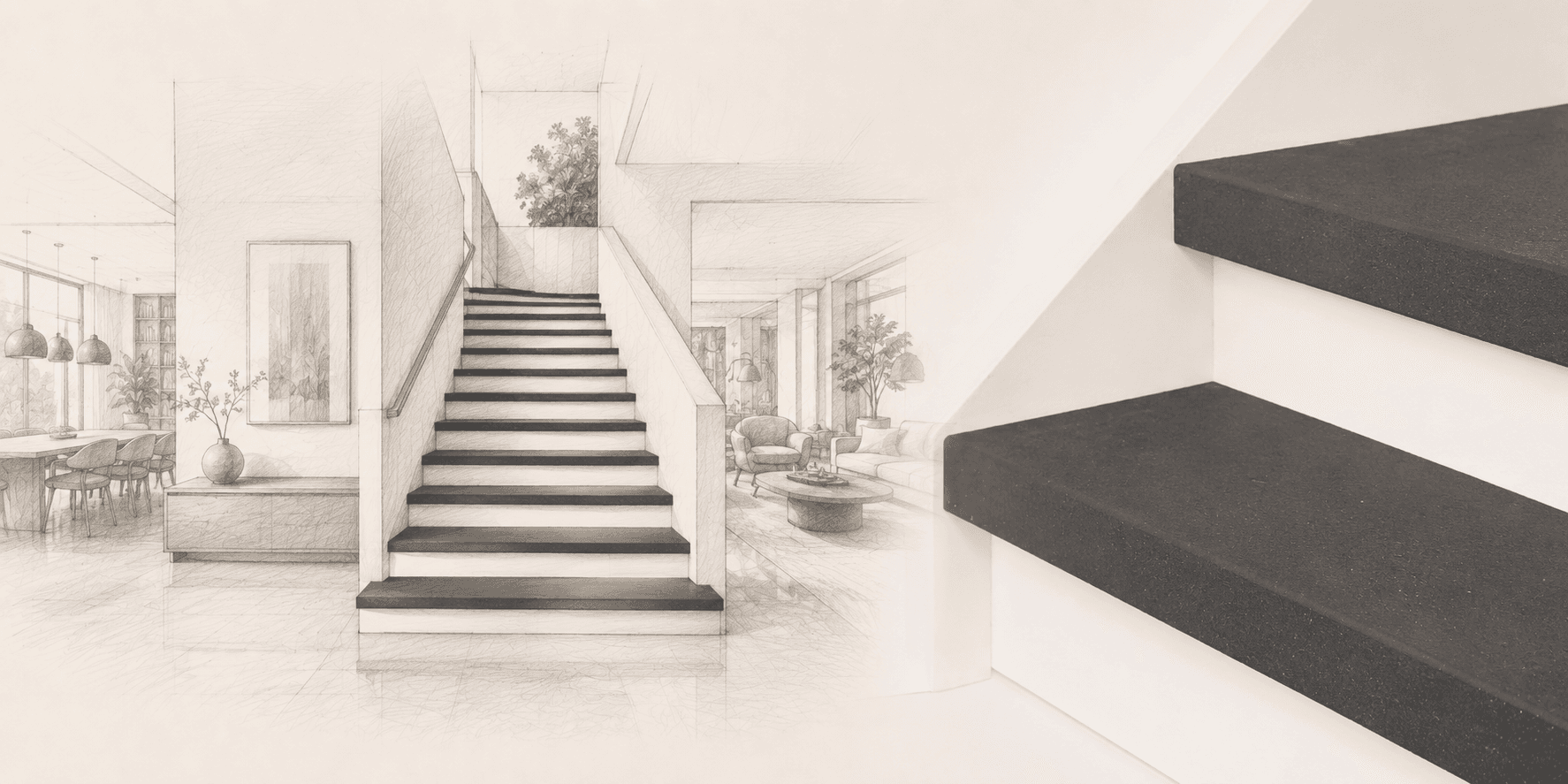
Natural stone stair renovation: everything you need to know
Discover everything about natural stone stair renovation. Compare materials, costs, maintenance, safety, durability and modern stone appearances for staircases.
Read more →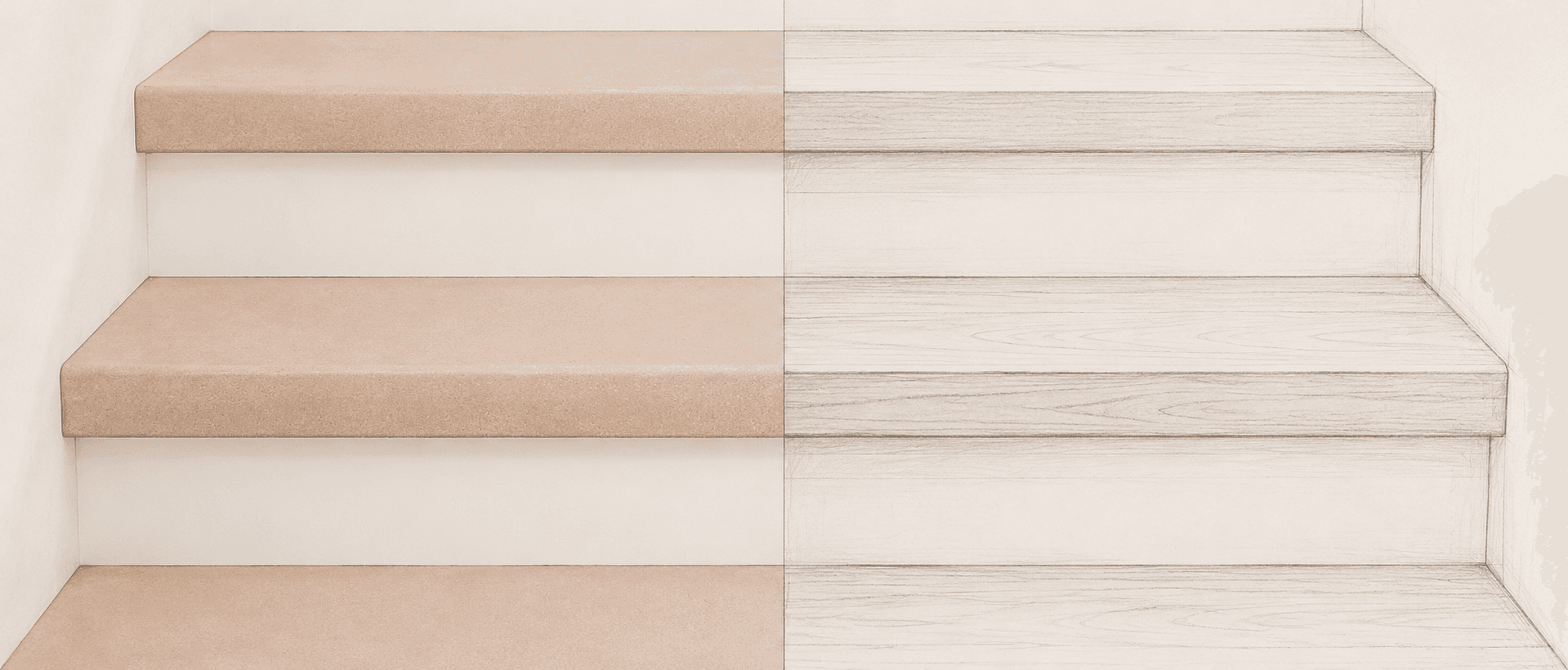
Natural stone staircase or PVC: what is the difference?
Unsure between a natural stone staircase or a PVC one? Compare appearance, maintenance, wear resistance, safety, lifespan and cost.
Read more →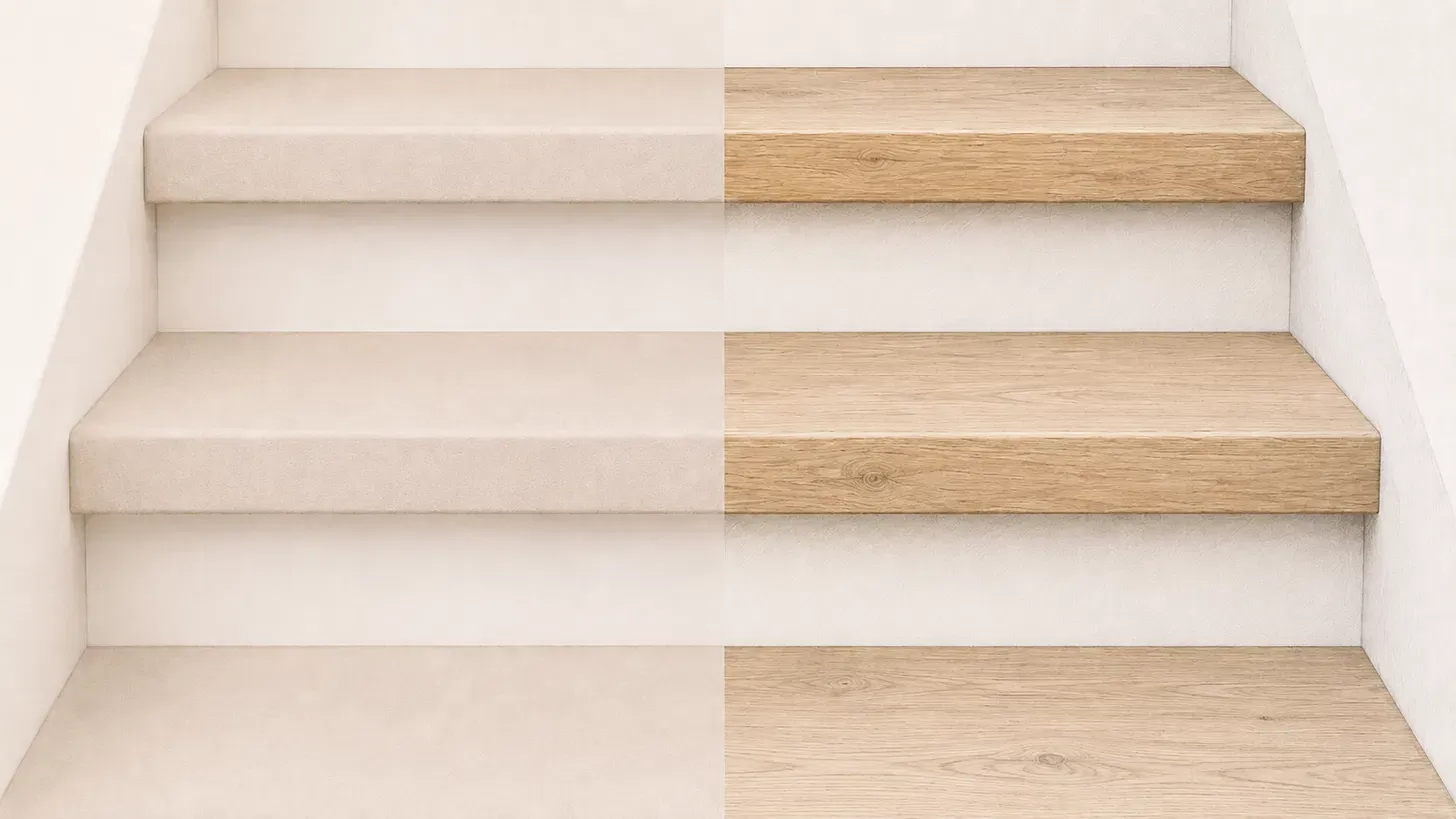
Natural stone staircase or wood: what is the difference?
Unsure between a natural stone staircase or a wooden one? Compare appearance, maintenance, wear resistance, safety, lifespan and interior style.
Read more →