Comparing stair renovation systems
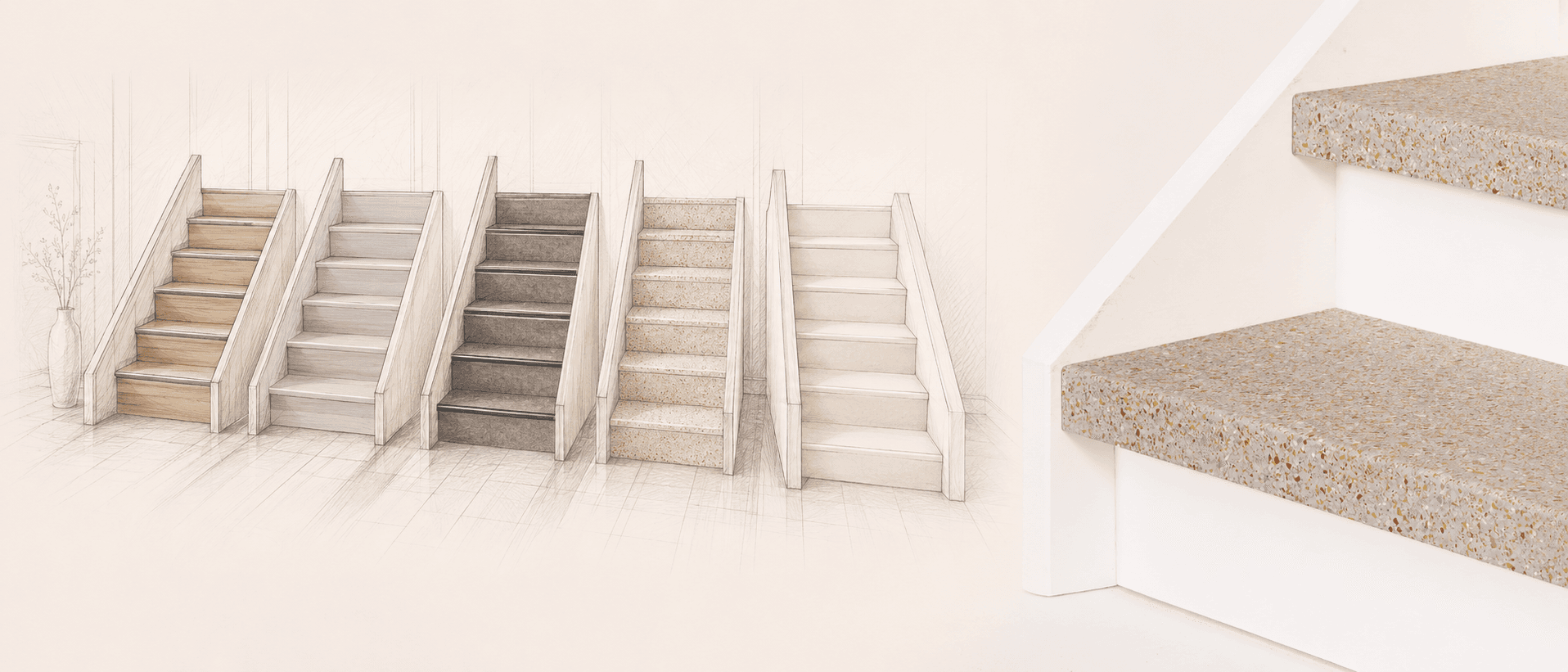
Anyone considering a stair renovation soon encounters a wide range of systems. Laminate, PVC, HPL, composite, mineral finish, recycled natural stone — the terms get mixed up and the claims are big.
In this article we place the most common stair renovation systems fairly side by side. Not to sell one system, but to help make a well-considered choice.
The most common systems
1. Laminate overlay treads
Laminate is one of the best-known materials for stair renovation in the Netherlands. It consists of an HDF core with a printed top layer and a protective coating.
The advantages are a wide choice of colours and designs, a relatively low purchase price and a familiar appearance. The points of attention: laminate is sensitive to moisture and wear on the stair nose, the anti-slip is in a separate strip or coating and not integrated into the material, it is more prone to visible wear under intensive use, and the printed appearance is visible on close inspection.
2. PVC overlay treads
PVC stair finish is popular for its price and ease of maintenance. The material is water-resistant and available in many designs.
The advantages are water resistance, ease of maintenance and a wide colour range. The points of attention: a plastic appearance that ages faster under intensive use, no real stone experience, and anti-slip via a coating or separate element.
3. HPL overlay treads
HPL (High Pressure Laminate) is a compressed plastic board with a higher density than standard laminate. It is widely used in the office sector.
The advantages are a higher wear resistance than laminate and more colour fastness. The points of attention: a printed appearance and anti-slip as a separate addition.
4. Recycled natural stone composite
A system in which the tread consists of recycled stone residual streams bound in a composite matrix. Just 4.3 mm thick, so no stair noses need to be cut back.
The advantages: a real stone appearance without print, anti-slip integrated into the material via the structure rather than as a separate addition, high mechanical strength aimed at long-term use, available in Stone Naturel, Stone Blend and Terrazzo, and suitable for homes and professional applications. For professional applications, EverStep Solid is available with additional technical documentation on slip resistance, fire behaviour and emission performance. The points of attention: a higher purchase price than laminate or PVC, and installation by an installer with system knowledge.
5. Seamless mineral finish (Signature)
A system built up entirely on site without prefabricated elements. No visible seams, maximum design freedom, also for organic and curved stair shapes.
The advantages: no visible transitions, colour fully bespoke, and suitability for complex stair shapes. The points of attention: a higher investment, a longer execution time, and a focus on bespoke projects and design interiors.
Comparison of main characteristics
Only recycled natural stone composite and seamless bespoke work offer a real stone experience; laminate, PVC and HPL work with a printed top layer. The same applies to integrated anti-slip: with composite and seamless bespoke work it is in the material, with the other three it is a separate addition. In thickness the systems vary considerably: laminate 12 to 15 mm, HPL 8 to 12 mm, PVC 4 to 8 mm, recycled natural stone composite just 4.3 mm, and seamless bespoke work variable. For professional use with additional technical documentation, EverStep Solid is especially equipped, while laminate, PVC and HPL are limited there and seamless bespoke work is on request. And in bespoke possibilities, composite (high) and seamless bespoke work (very high) clearly score above the plastic systems.
What does a comparison not tell you?
Comparison tables give a general picture, but say nothing about the specific situation. The right choice always depends on the stair shape, the use, the desired appearance and the available budget. An Omnistair installer with system knowledge assesses the situation on site and advises which system fits best.
Further reading
Want to explore further? Read also which stair renovation suits me?, painting stairs or stair renovation? and the difference between Omnistair and traditional stair renovation. More about the system itself is in what is the Omnistair system and why multiple product lines.
Want to know which system suits your staircase best?
The right choice always depends on your specific staircase, use and wishes. Via omnistair.nl you can request an appointment for an on-site assessment.
Frequently asked questions
That depends on the situation. For homes with a preference for a stone appearance, recycled natural stone composite scores high on appearance and anti-slip. For a low budget, laminate is an entry-level option.
Laminate has a printed appearance and anti-slip as a separate addition. Recycled natural stone composite has a real stone structure and integrated anti-slip — and is just 4.3 mm thick.
For owners' associations and professional applications, EverStep Solid is available with additional technical documentation. An installer with system knowledge advises per situation.
Not by definition. A thicker tread can mean the stair nose has to be cut back. Recycled natural stone composite at 4.3 mm fits directly over the existing tread in most cases.
Yes, but the right choice depends on the stair shape and situation. An installer with system knowledge advises based on an on-site assessment.